International Round table on the challenges of working with chronic conditions
On 15 June 2026, the Doctoral Committee of the Clinical and Health Psychology Programme organised the round table “Working with Chronic Conditions: Challenges for Psychologists and Researchers”, an academic activity addressed to faculty members and students of the Faculty.
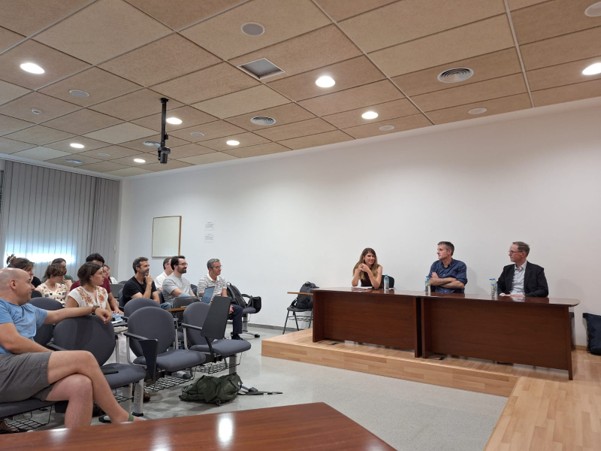
The session brought together two internationally recognised experts in clinical and health psychology: Prof. Lance McCracken, from Uppsala University, and Dr. Matthew Lebowitz, from Columbia University. The round table was moderated by Dr. Beatriz Olaya, professor at the Department of Clinical and Health Psychology of the Universitat Autònoma de Barcelona.
The seminar addressed some of the main challenges involved in working with chronic conditions, both in clinical practice and in research. The discussion focused on the need to understand long-term health problems from an interdisciplinary and person-centered perspective, taking into account their complexity and the limitations of overly rigid diagnostic or treatment frameworks. A central contribution came from Prof. Lance McCracken, whose work focuses on chronic pain management, psychological flexibility and Acceptance and Commitment Therapy. Drawing on his expertise in contextual behavioral science, he reflected on the need to move beyond rigid models and treatment protocols towards more integrative and personalized approaches that help clinicians identify relevant processes of change and adapt interventions to individual needs. Prof. Matthew Lebowitz complemented this clinical perspective by focusing on how people understand and explain mental and physical health conditions. His work examines how biomedical and psychosocial explanations can shape attitudes, expectations, stigma and perceived agency among patients, clinicians and the general public, opening a broader reflection on the role of explanatory models in chronic conditions.
During the round table, participants reflected on the usefulness, but also the limitations, of current clinical guidelines, randomized controlled trials and diagnostic categories. One of the key ideas discussed was that, although guidelines are useful for clinical practice, they need to be applied with flexibility, especially when working with people whose difficulties do not fit neatly into predefined clinical categories. The discussion also highlighted the importance of personalization in psychological care. Chronic conditions often involve high individual variability, and clinical work requires attention not only to symptoms or diagnoses, but also to functioning, context, values and the person’s own way of making sense of their condition. In this sense, the seminar underlined the need to bridge the gap between research evidence, clinical decision-making and the lived experience of people with chronic health problems.
Overall, the seminar offered a space for reflection on how psychology can contribute to improving care for people living with chronic conditions. Through the perspectives of both speakers, the session highlighted the importance of integrating psychological knowledge into complex healthcare contexts and developing approaches that are not only evidence-based, but also flexible, functional and centred on the person.