Estrella Ferreira García, professor in the Department of Clinical and Health Psychology, participated in the international congress of the Spanish Society for the Advancement of Psychological Assessment (SEAEP)
Held on May 14 and 15, 2026, at the Faculty of Psychology of the University of Salamanca and organized by SEAEP.
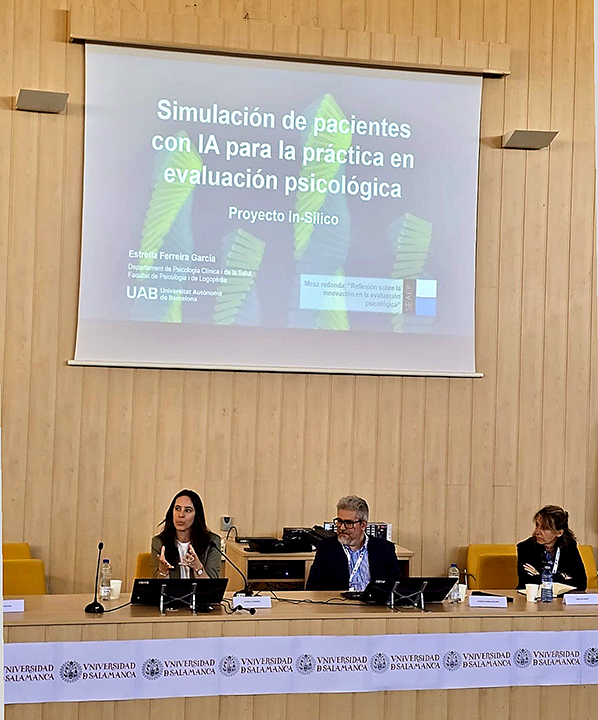
Within the framework of the 1st International Congress on Advances in Psychological Assessment, Professor Estrella Ferreira, from the Department of Clinical and Health Psychology at UAB, presented the progress of the educational innovation project “In Silico.” The presentation took place during the round table entitled “Reflection on Innovation in Psychological Assessment: Some Experiences,” which she shared with Carolina Marín from the Complutense University of Madrid, who presented the online educational platform Salware.
In her presentation, entitled “AI Patient Simulation for Training in Psychological Assessment. The In Silico Project,” Professor Estrella Ferreira presented the progress of this educational innovation project (PID2025 UAB), led by principal investigator Albert Feliu and focused on training basic clinical skills. During the talk, she explored how the integration of synthetic patients generated through GPT-based bots allows Psychology students to practice fundamental competencies such as active listening, question formulation, and empathic responding in a safe and repeatable environment.
Ferreira highlighted the system’s ability to transform static clinical cases into active learning experiences, providing students with immediate feedback and a structured debriefing process essential for reflecting on their own performance. She presented evidence regarding the project’s effectiveness, emphasizing that the system demonstrated excellent usability. She also noted that students perceived a significant improvement in their ability to organize clinical interviews and apply theoretical content to realistic practical situations.
Although she also discussed the limitations encountered, such as the lack of observable nonverbal communication, she stressed that this technology represents a scalable and effective complement that enables students to face professional decision-making before entering real clinical practice.
The group’s participation in this international congress reinforces its commitment to educational innovation and its contribution to advancing knowledge on the application of artificial intelligence in clinical training. The results presented support further development of active learning models that integrate the use of synthetic patients to enhance students’ perception of competence and excellence in the psychological assessment of future professionals.