Indigenous Peoples and local communities must have a greater say in global biodiversity assessments
A new international study involving ICTA-UAB presents guidance for stronger inclusion of Indigenous Peoples' and local communities' knowledge within the Intergovernmental Science-Policy Platform on Biodiversity and Ecosystem Services (IPBES).
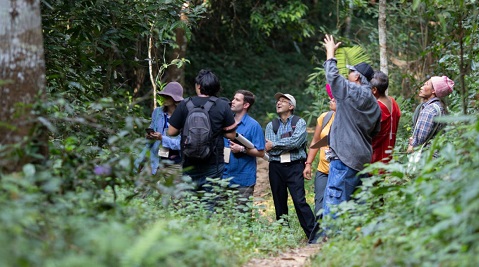
The study acknowledges that IPBES is arguably the frontrunner in working across diverse knowledge systems, noting that a productive shift is underway in how the panel works, but argues that more ambitious change is needed.
"We need to work across scientific, Indigenous and local knowledge systems to understand the complexities of biodiversity loss. It requires diverse perspectives to prevent the narrowing of alternatives and enable transformative change towards a just and sustainable world," says Maria Tengö, researcher at the Stockholm Resilience Centre and lead author of the study.
Published in the journal People and Nature of the British Ecological Society, the study brought together an international team of scientists and Indigenous and local knowledge holders from Australia, Sweden, Germany, Hawai'i, Spain, the Philippines, and Thailand.
“One of IPBES’s main missions is the production of reports on the state of biodiversity at the global level,” explains ICTA-UAB researcher Álvaro Fernández-Llamazares, co-author of the study. “It is essential that these reports are grounded in all available evidence, and this means making an effort to ensure that Indigenous and local knowledge is represented accurately and respectfully.”
The authors identified that the synthesis phase, when rich information is distilled into key messages for decision making, is often where the diversity of knowledge is lost or hidden. To address this, they set out to "unpack the task of synthesis when weaving different knowledge systems together” in biodiversity assessments and conservation.
A challenging task
According to the authors, synthesizing knowledge from different actors is indeed a complex task, as it involves knowledge conflicts, tensions between diversity and consensus, as well as political and power dynamics. Yet little guidance exists in the scientific literature about how to navigate these challenges. To tackle this issue, the authors drew on a literature review and reflections from the co-author team based on their participation in three IPBES assessments.
Fernández-Llamazares contributed observations based on his role as an author in two of these global reports. “It is essential to understand synthesis in a much broader and more inclusive way. The scale of global biodiversity loss requires us to put all existing knowledge on the table and to be capable of communicating it effectively and rigorously,” explains Fernández-Llamazares.
This includes working with diverse actors to address power imbalances; building governance structures that incorporate justice, rights, and attention to the healing of historical traumas; and creating spaces for genuine contestation of ideas. Developing shared capacities for reflection and learning is key to navigating disagreement productively. So too is promoting Indigenous and local leadership, funding opportunities for communities to practice and apply their own knowledge, and recognising that different knowledge systems may relate to time in fundamentally different ways.
Multiple Evidence Base
Their conclusion is clear: implementing this guidance will help ensure that knowledge co-production efforts drive genuinely transformative change, not just incremental steps. This matters because any science-policy process that aims for deep, lasting change will inevitably encounter competing narratives and opposing viewpoints. Navigating these tensions fairly across different ways of knowing, is what socially just synthesis requires.
With this in mind, the authors are convinced that their analysis holds value well beyond IPBES itself: “Our analysis provides explicit and ambitious guidance for changes in IPBES for an effective forward path – very timely for the second Global assessment that has just started. If broadly implemented, these steps would represent significant systemic change within IPBES, with high relevance for other science-policy-practice platforms at local, regional and global level.”
Article of reference: Tengö, M., Díaz-Reviriego, I., Fernández-Llamazares, Á., Malmer, P., Alangui, W. V., Pascua, P., Trakansuphakon, P., & Hill, R. (2026). Unpacking the task of synthesis when weaving knowledge systems for biodiversity assessments. People and Nature, 00, 1–18. https://doi.org/10.1002/pan3.70343