
Blanca Pujals: “Many countries back science not only for knowledge, but also for political reasons”
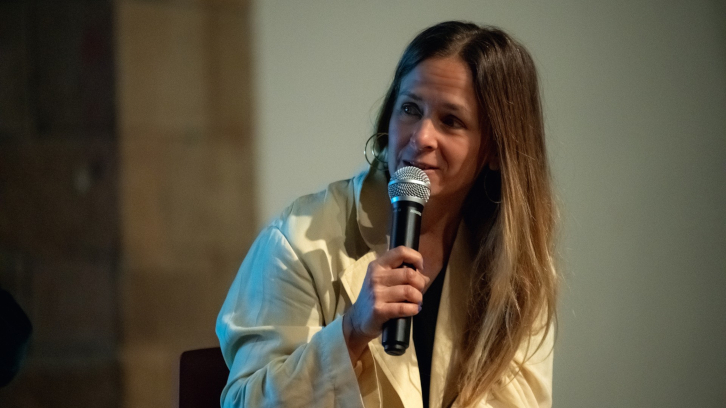
Blanca Pujals, architect and researcher of the spaces and infrastructures of science, participated this past 4 February in the seminar “Images as thought: Dialogue between art, science, history and philosophy”, organised by the Institut d’Història de la Ciència of the UAB.
Blanca Pujals is graduate in Architect from the UPC and researcher of scientific spaces and infrastructures. She received her PhD in Philosophy, Visual Cultures and Materials from the University of Northumbria, in collaboration with the Baltic Centre for Contemporary Art, with the project “Sensing Infrastructures: A spatial examination of soft power, the neutrino particle and underground fundamental physics laboratories”, where she examined the geopolitics of particle physics infrastructures such as CERN, the Canfranc underground laboratory, and Antarctica. She was recently involved in the audiovisual project “Sensing Quantum Infrastructures” and “Synthetic Universe: Quantum Spectral Traces”, with the CCCB and Hangar, both within the long-term project “A Synthetic Universe” (under the GRAPA programme of artistic accompaniment from the CCCB).
Her interdisciplinary research and projects address the political and material dimensions of techno-scientific infrastructures, the geographies of power over regions and people, and the geopolitics of materials. Her work has been displayed in many different ways: from audiovisual installations, architecture and conferences, to teaching and writing.
In this context, he participated on February 4 in the seminar “Images as thought: Dialogue between art, science, history and philosophy” at the Institute of History of Science, which can be seen recorded here.
What is your field of research?
I come from architecture, but I have always been very interested in the regional effects of everything that is material. I am now investigating geopolitics of materials with a project on rare earth elements and the impact it has on sustainability and other territories. In my PhD research I questioned scientific neutrality on material infrastructures, because science is never neutral and has an impact on its surroundings. Based on infrastructures and neutrinos, a very poetic particle for the project, I unfold all the relationships between energy, material impact, soft power, scientific diplomacy, etc.
What do you study in relation to neutrinos, and how?
The neutrino for me was, without wanting to make an analogy, a way to understand what neutrality is. In science, it means without charge, for example. The fact of not having a charge is very interesting, it is very generative and opens up possibilities instead of staying within a closed positive-negative binomial. This is the most philosophical part about the neutrino, and I use it to look at the infrastructures that generate or study the neutrino, the neutral particle, and from seeing what information on scientific non-neutrality it gives me by analysing its infrastructures.
You mentioned soft power before. What is it and what implications does it have in physics and science in general?
There are two types of power, hard and soft. The hard one is war, coercion. Soft power is what is done through, for example, science, culture, sporting events, etc. Science, since it has such large and sophisticated infrastructures, needs to collaborate between different countries in order to build an experiment. This generates a dependency, a collaboration between countries that is scientific diplomacy, or soft power. An example in science is Antarctica, a continent dedicated to science and peace. Mineral prospecting cannot be carried out there and there cannot be military bases. Many countries do so in favour of “progress”, but they back science not only for knowledge, but for strategic and political reasons. For example, quantum physics was very important during World War II for nuclear weapons. Even if after the war it became the science of the Atoms for Peace —and the construction of CERN was done precisely to avoid any energy resource conflicts between European countries— the countries knew and know now that controlling nuclear energy is very powerful.
What geopolitical differences are there between the macro laboratories you have focused on in the field of physics and other laboratories in fields such as biology?
I have not studied the infrastructures of chemistry or biology, so I do not know them that well. But, for example, Covid was a case of geopolitics and soft power that we experienced, with vaccinations and pharmaceuticals. In the geopolitical field, biology plays a great role, both in terms of military development and public health. The difference would be rather in the magnitude of the machine needed to look at something far back in time and very small in space, which is necessary in quantum physics. This is the difference: the dimension and the material and energy impact of these experiments, because collaboration occurs in all scientific fields. The other peculiarity of particle physics that interested me is that it is financed with public money and, therefore, there are no private interests involved, and this attracted me especially in relation to the will of “neutrality”.
As for geopolitics, CERN is a “state of states”; it is a plurinational state, with a border that you must cross to enter, since it does not belong to France or to Switzerland.
What concrete examples of these geopolitical impacts can be seen in places such as the Canfranc Underground Laboratory, CERN or Antarctica?
CERN became, after the Second World War with the Atoms for Peace, the first collaboration between European countries to prevent another war for resources, nuclear or energy. It was created to investigate together, and this is already soft power.
In the case of Canfranc the impact is not as big. Although it is under the Franco-Spanish border, it is not soft power, but rather a case of international collaboration. It is a very small laboratory with a small local team of scientists tending to the machines and experiments, but they are collaborating with very important international projects such as the Super-Kamiokande neutrino observatory in Japan and with other scientific super-equipments from all over the world.
And Antarctica because it is a whole continent dedicated to “science and peace”. A very representative—and surprising—example of this geopolitics was seen in the scientific bases of Russia and Chile, which are very close to each other. Both have their own church, one Orthodox and the other Catholic. Surely it is to offer “spiritual accompaniment” to the scientists, but from my point of view religion is also placed in the Antarctic as a geopolitical appropriation of the territory, even if it is dedicated to science and peace.
Since the Second World War Big science has developed greatly with large spaces and collective research teams. For the next few years there are projects such as the CERN Future Circular Collider with a circumference of more than 90 kms. Is all this collaborative science a real model of science for peace?
There is a problem with this. It means more energy and CERN is very aware of the consumption it has, because it is high energy physics. They use nuclear power from France, but a larger ring, to find more particles and have more speed, will need more energy. In theory the current particle accelerator has reached its limit, so they are making a ring with a larger diameter. They have already begun to develop it, in part, because China wanted to make a collider, although they have already dismissed the project.
Do you think this is the future of science?
If I were a particle physicist, I would tell you that it is very necessary. And I'm fascinated by it. Currently, however, from my point of view, science should be very focused on understanding climate change, we must come together and collaborate to change a system of energy consumption and exploitation of planetary resources, humans, animals, etc., that has proven to be a failed model. I do not agree with transhumanism and the idea that with technology humans can do anything. We are moving towards more delirious projects, an example are the SpaceX rockets, which in addition to contaminating the atmosphere with each launch, propose colonising other planets as a solution, instead of taking care of ours.
I would like to think about a science linked to society, which makes sense and is coherent with the current moment. It may be possible to later go another way, but now there are some fundamental needs we must address.
You have mixed art and science in a very interdisciplinary way in your projects and research. How did that come about?
It has always been difficult for me to understand architecture without being linked to other practices, but especially during my time at the Centre for Research Architecture (Goldsmiths, London), I was able to talk about architecture while using audiovisual formats. By using these tools—video, photography or text—the exhibition area allows expanding the communication of certain spatial research to places where it would not otherwise reach. Also, in England it was much easier to apply my interest in working from a perspective of architecture, audiovisual practices and scientific knowledge, because historically this transdisciplinarity is much more accepted, to the point that my doctorate was in Art&Science.
And how do the tools of audiovisual creation and art help you to explain and think about scientific infrastructures?
I often use videos as a tool for architectural thinking, as if they were sketches to understand the material, to think—if I need to do it visually—and to put the materials I am working with in a visual and aural relationship. With the doctorate I made videos as process sketches, they have never been a piece I consider finished. They are like partial editions of the projects. For example, I have hours of shooting in Antarctica, and I could make a movie out of it. Maybe it's what I should do now, I would like that.
Bernat Solà Jorge
Communication and Promotion Area
Universitat Autònoma de Barcelona