«Addressing environmental crises requires social change, not just technical change»
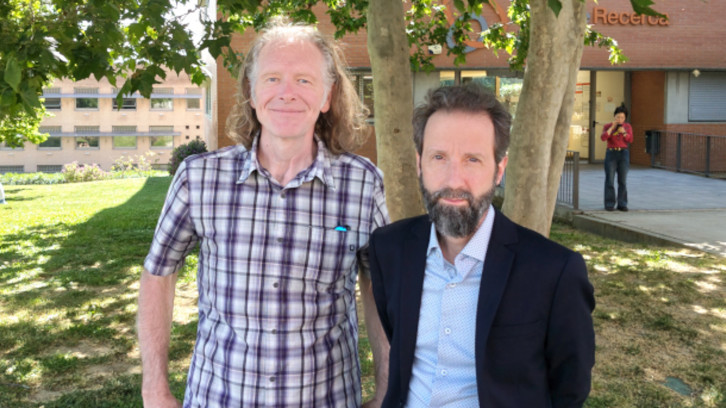
Richard York and Stefano B. Longo, environmental sociologists specialising in ecological crisis, inequality, and political economy, participated in the seminar “Environmental Sociology, Ecological Crisis & Degrowth” held at the ICTA-UAB. The session explored the social dimensions of environmental degradation, the limits of technological solutions, and the role of inequality in shaping both the causes of and responses to ecological crises.
Richard York is a sociologist and a leading scholar in environmental sociology. His research examines how social structures, inequality, and economic systems shape environmental outcomes, with a particular focus on energy use, ecological degradation, and the limits of technological solutions.
Stefano B. Longo is a sociologist specialising in environmental sociology, with research focused on marine ecosystems, fisheries, and the social dynamics of resource exploitation. His work analyses how systems of production, commodification, and inequality influence environmental sustainability and ecological crises.
On 28 April, they participated in the seminar “Environmental Sociology, Ecological Crisis & Degrowth”, which examined how growth-driven economic systems push societies beyond ecological limits and hinder more just and sustainable alternatives.
How do you define an ecological crisis from a sociological perspective and from a historical point of view?
S: There are social processes that are beyond the individual which, in aggregate, have impacted ecological systems throughout history. Current social arrangements have created forces and processes resulting in overshoot or serious ecological degradation on multiple fronts.
R: There are very severe ecological crises in the world, and they are intertwined with social processes. Much of this relates to inequalities that lead to bad social outcomes such as poverty, and it is also connected to ecological crises, where the rich and corporations exert a great deal of control over society through the structure of political economies. Addressing environmental crises requires social change, not just technical change. These crises are often presented as requiring only a few new technologies, but we see them as integral to the structure of how societies work.
What distinguishes these approaches from a purely scientific point of view of the ecological crisis?
S: We have different levels of analysis. Natural scientists tend to examine biophysical conditions, outcomes, and relationships, but our work goes further. We not only seek to understand those, but also to place them in the context of social conditions and how they are interrelated, a different method and approach to science. That work is integral to what we do, but it is not enough, because this crisis is historical and social. We have to understand the historical and social processes related to it.
R: Our work does not stand in contrast to natural sciences; we fully support that work. Natural sciences identify that there is a climate crisis generated from burning fossil fuels, and we fully agree. What we seek to address is: why do we use so many fossil fuels? It has historical origins. Natural science clearly indicates that we need to stop using fossil fuels; we seek to understand what needs to change in social and economic relations to achieve that goal.
Richard, green technologies and artificial intelligence are increasingly being proposed as key tools to address environmental challenges. What is your assessment of their potential and limits? Could they be a solution or part of possible solutions?
R: Much of my research has found that in practice, the implementation of green technologies often does not work as expected. When alternative energy is produced within current social structures, energy consumption tends to increase rather than fossil fuels being eliminated. This does not mean green technologies never work, but their effectiveness depends on social organisation. In the current system, they are not necessarily effective. As for artificial intelligence, given historical patterns, there are grounds for scepticism about claims that it will solve these problems, particularly because AI systems consume a significant amount of energy.
Stefano, your research on fisheries and marine ecosystems has exposed the deep contradictions between capitalist extraction and ecological sustainability. What can these specific cases teach us about the broader dynamics of environmental degradation?
S: Fishing technologies can be applied in different ways for different outcomes. Whether a technology is sustainable or not depends not on the technology itself, but on how it is employed within its context. Some technologies are more amenable to addressing environmental concerns than others.
What matters is how these technologies are being employed, for what purposes, and by what means. The research suggests that systems of commodification and accumulation are the key drivers of decision-making. In the fishery sector, for example, when decisions are made primarily in relation to profitability, outcomes can diverge greatly from what would be considered the main objective, which is to produce food.
It is always necessary to step back and examine the context: why is this being done, and how? The objectives are typically not feeding people or sustaining the environment and fish populations. These considerations come later, because for most enterprises, the first priority is to remain profitable.
How does inequality shape both the causes of the crisis and the types of solutions such as degrowth, that we can imagine?
R: Take the example of rising sea levels. A rich nation like the Netherlands can afford to build sea walls, while a poor nation like Bangladesh does not have the resources to do so. Rich nations burn most of the fossil fuels, creating the crisis, but poorer nations like Bangladesh will be the most severely affected. Similarly, nations in sub-Saharan Africa have used relatively few fossil fuels, yet their livelihoods can be dramatically disrupted by droughts. Affluent people can afford to avoid or manage the problems, meaning those who created the crisis have less incentive to solve it. Environmental justice research has pointed to this as one of the key reasons it is so hard to fix the problem: if those who created it faced more severe consequences, they would have greater incentive to address it.
S: This dynamic applies to any kind of crisis. Those with more resources have the means to address, adapt, and deal with problems, whether in health, food, or any other domain. It is not surprising that ecological problems produce magnified consequences for people with fewer resources. This returns us to the fundamental issue: the vast division of resources and inequality has implications on multiple fronts. Addressing these problems requires addressing inequality; it is not simply a matter of engineering solutions. If inequality were tackled, that would place us at the forefront of dealing with environmental problems.
Is degrowth a genuinely transformative path toward a more just society, or does it carry too many risks and uncertainties to be a realistic alternative?
S: There are many different definitions of degrowth, but the generic notion of degrowth as a crisis stems from the current system of production. Perhaps the question should be: what kind of system of production could be envisioned in which degrowth is not a crisis, one that creates greater well-being? Life needs to be reorganised in a way in which the issues considered important are not a crisis but contribute to greater well-being. That said, we are already in crisis.
R: Capitalism is dependent on growth, which creates problems, and it tries to fix its crises through technology because it does not want to confront the fundamental contradiction of its growth dependence. The claim of degrowth is a radical statement, but it is not unrealistic. It would require a very different form of social organisation, and within such a different social order, green technologies might genuinely be helpful if properly deployed.
S: Whether we call it degrowth, eco-socialism, or ecological democracy, it is not what we have now, because what we have now is not amenable to dealing with the ecological crisis.
How do you think academic and science communication have tackled the ecological crisis?
S: Some outlets have done a good job, but mainstream outlets (newspapers, international news or government channels) generally have not. They tend to be stuck in a “technological fix” worldview. There are critical news outlets trying to engage with these issues differently, but radical solutions are often pushed to the margins. The outlets doing the best job are those on the margins; mainstream ones are not.
R: There is considerable variation. Some science communicators are very good, but mainstream media generally is not. It is particularly poor in the United States, where media coverage of these issues tends to be especially inadequate.
S: Based on experience in other countries, the US is particularly poor in this regard, but even in Europe —including Sweden, which is at the forefront of sustainability— the media landscape tends to be rather generic. Not wanting to appear extreme, outlets fall into simplistic discussions and highlight small cases of progress without engaging with deeper contradictions.
Divulga UAB
Communication and Promotion Area
Universitat Autònoma de Barcelona