The 1st CLARIAH-ES Conference on Libraries Highlights Digital Infrastructures as Drivers of Open Science
Libraries have ceased to be mere preservation spaces and have become key infrastructures in the circulation of knowledge. The 1st CLARIAH-ES Conference on Libraries demonstrated how digital infrastructures and Open Science are redefining their role in research.
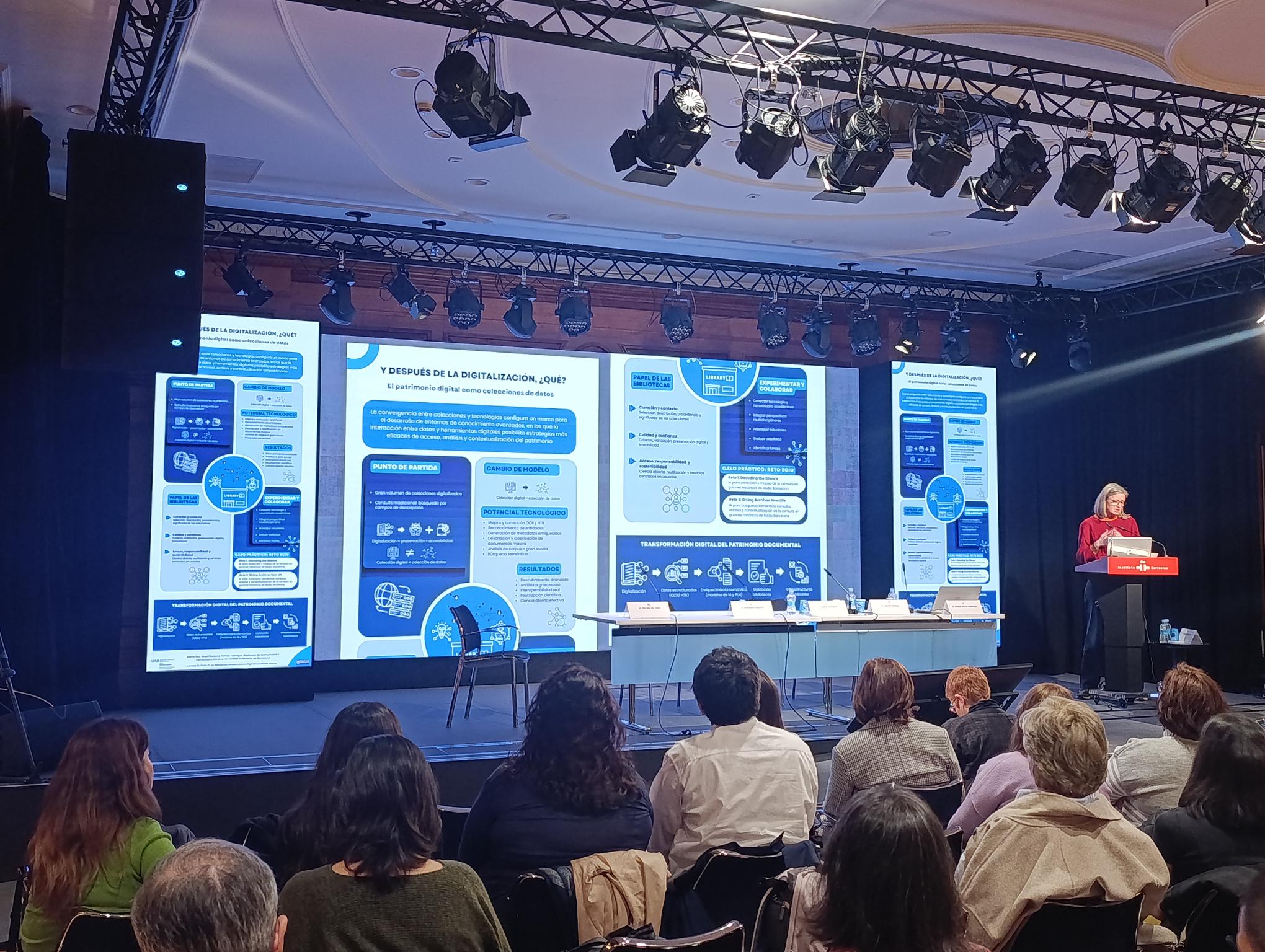
How does a library or archive become the engine of 21st-century science? This was the central question at yesterday’s 1st CLARIAH-ES Conference on Libraries: Digital Infrastructures and Open Science, held in Madrid. The event served as a meeting point for professionals from libraries, archives, and GLAM institutions keen to explore the potential of digital infrastructures in contemporary research.
With a clear educational focus, the conference made concepts often perceived as complex—Research Infrastructures, data management, interoperability, or scientific clouds—accessible through plain language and practical examples. The aim: to demystify technology and view it as an ally in improving library management, increasing institutional visibility, and facilitating a more collaborative and democratic Open Science.
The first session showcased key European initiatives such as CLARIN and DARIAH, which are essential for working with textual data and Digital Humanities projects. The European Open Science Cloud (EOSC) was also presented, a major European infrastructure that enables the sharing, preservation, and reuse of scientific data. The second session demonstrated practical applications of these tools, showing how traditional collections can be transformed into open and linked data. The day concluded with reflections on the democratizing mission of libraries within Open Science, highlighting their role in fostering trust, quality, and sustainability.
In this context, the Universitat Autònoma de Barcelona presented two experiences exemplifying this transformation. The first, “Digital Humanities and University Libraries: The Case of UAB”, focused on Digital Humanities at UAB, highlighted the consolidation of an ecosystem with dozens of ongoing projects, active research groups, and institutional partnerships. The UAB Digital Humanities Portal serves as a platform for visibility and connectivity, while the Library Service assumes a strategic role by providing specialised technical support, advice, and management of digital infrastructures, positioning itself as a key partner in research projects.
The second presentation, “And after digitisation, what?”, addressed the paradigm shift required to understand digital heritage as data collections. Beyond preservation and access, it is about structuring, enriching, and linking information using technologies such as OCR/HTR, entity recognition, and large-scale corpus analysis. In this process, libraries become guarantors of context, quality, and interoperability, promoting reusable infrastructures and actively contributing to effective Open Science.
The shared conclusion was clear: 21st-century libraries do not merely safeguard documents; they transform collections into reliable, contextualised, and open data, connecting people, technology, and knowledge for the benefit of the research community and society at large.
The UAB, with the Sustainable Development Goals
-
 Partnerships for the goals
-
 Sustainable cities and communities