The UAB reflects on the challenges of journalism education in the age of artificial intelligence
The UAB's Communication and Education Office organised a conference to discuss new skills, teaching methodologies and the ethical challenges posed by the integration of AI into the training of future communication professionals.
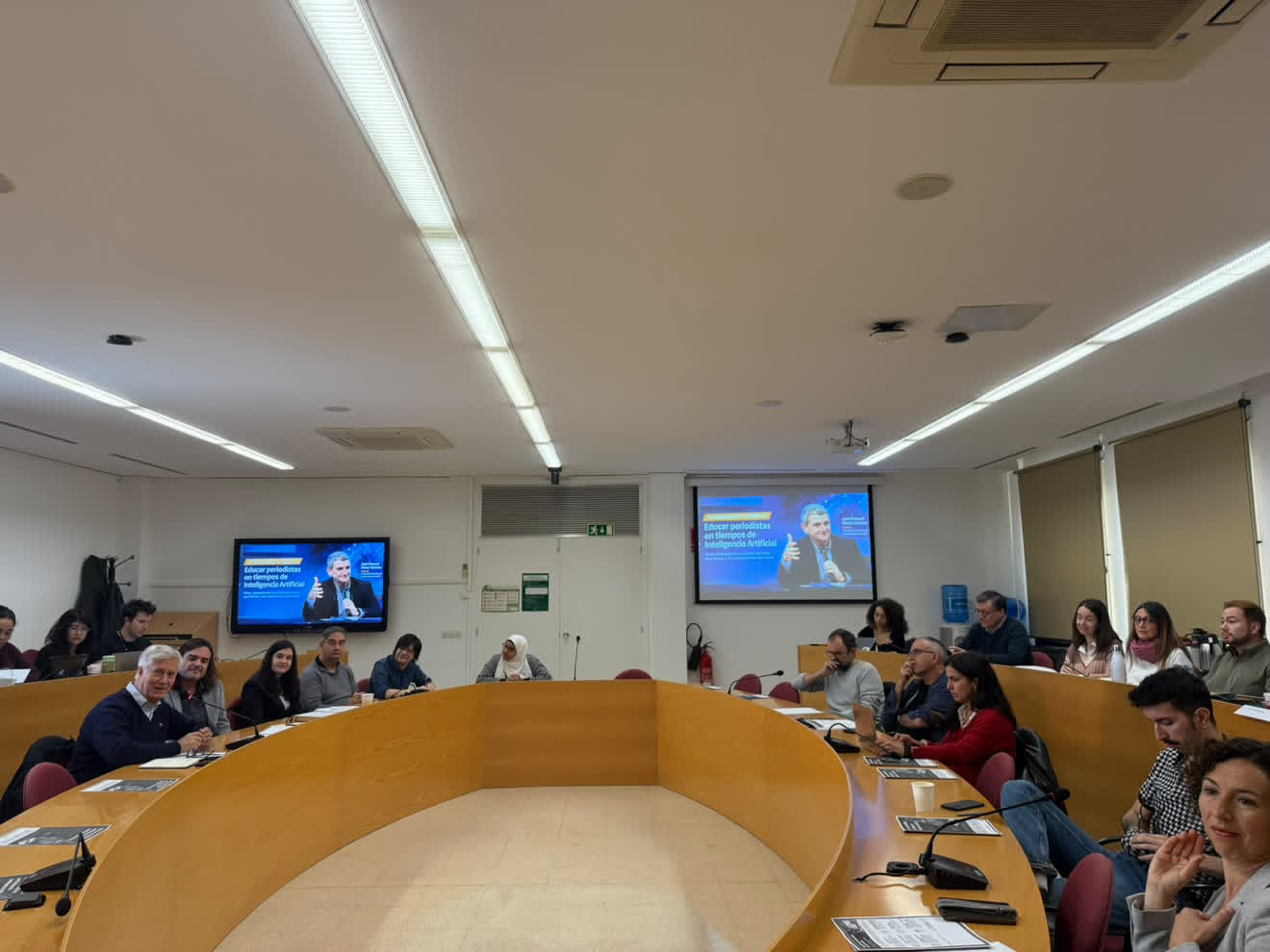
On Friday, 6 November, the Faculty of Communication Studies hosted the conference “Educating Journalists in the Age of Artificial Intelligence: Challenges, Skills and Teaching Models for Training Future Communicators”, organised by the UAB's Communication and Education Office.
The event brought together researchers, educators and communication professionals to reflect on how the emergence of artificial intelligence is transforming journalism education and highlighting the need to rethink university training for future communicators.
Throughout the conference, held in the Faculty's Boardroom, three main thematic areas were addressed. The first focused on the profile of the journalist of the future, with particular attention to critical thinking, media literacy, creativity and content verification. The second session explored the integration of AI into the classroom, new learning methodologies and assessment models. Finally, the third focused on the ethical challenges associated with these technologies, including academic integrity, transparency, copyright, algorithmic bias and privacy.
The conference was conceived as a space for discussion and the exchange of experiences, with the aim of sharing good practices and identifying proposals for integrating artificial intelligence into teaching from a critical, responsible and pedagogically sound perspective.
Among the participants were José Manuel Pérez Tornero, head of the Cooperation Program in the field of Media Literacy and Intercultural Dialogue of UNESCO; Santiago Tejedor, director of the UAB Department of Communication and Education and professor of the Department of Journalism and Communication Sciences of the UAB; Cristina Pulido, director of the Department of Journalism and Communication Sciences of the UAB; Beatriz Villarejo, professor of the Department of Journalism and Communication Sciences of the UAB and researcher of the IA-COM project. Researchers and professionals such as Michele Catanzaro, Laura Cervi, Juan Francisco Jiménez, Pepe Verón, Pilar Sánchez-García, David Rull, Andrea De-Santis, Jesús Martínez, David González, Albert Sarabia, Mariann Estafanía Soto also participated.
This initiative was part of the OI2 (Observatory for Innovation in News Media in the Digital Society) and IA-COM projects, promoted by the UAB's Communication and Education Office. The event formed part of an ongoing line of work aimed at analysing the impact of artificial intelligence on journalism, communication and education, and promoting its ethical and responsible use.
Through this conference, the Office fostered a space for shared reflection on the role of universities in a context of technological transformation and on the skills needed to train future communication professionals.