The students of the Faculty win the Arcadi Oliveres Prize 2026 for their TFG for global justice
The commitment to global justice and social transformation have been the central axes of the Final Degree Projects of Andrea Mendieta Sánchez and Núria Mir Dorn (Communication of Organizations) and Ada Solà Conesa (Journalism), awarded in the 9th edition of the Arcadi Oliveres Awards 2026.
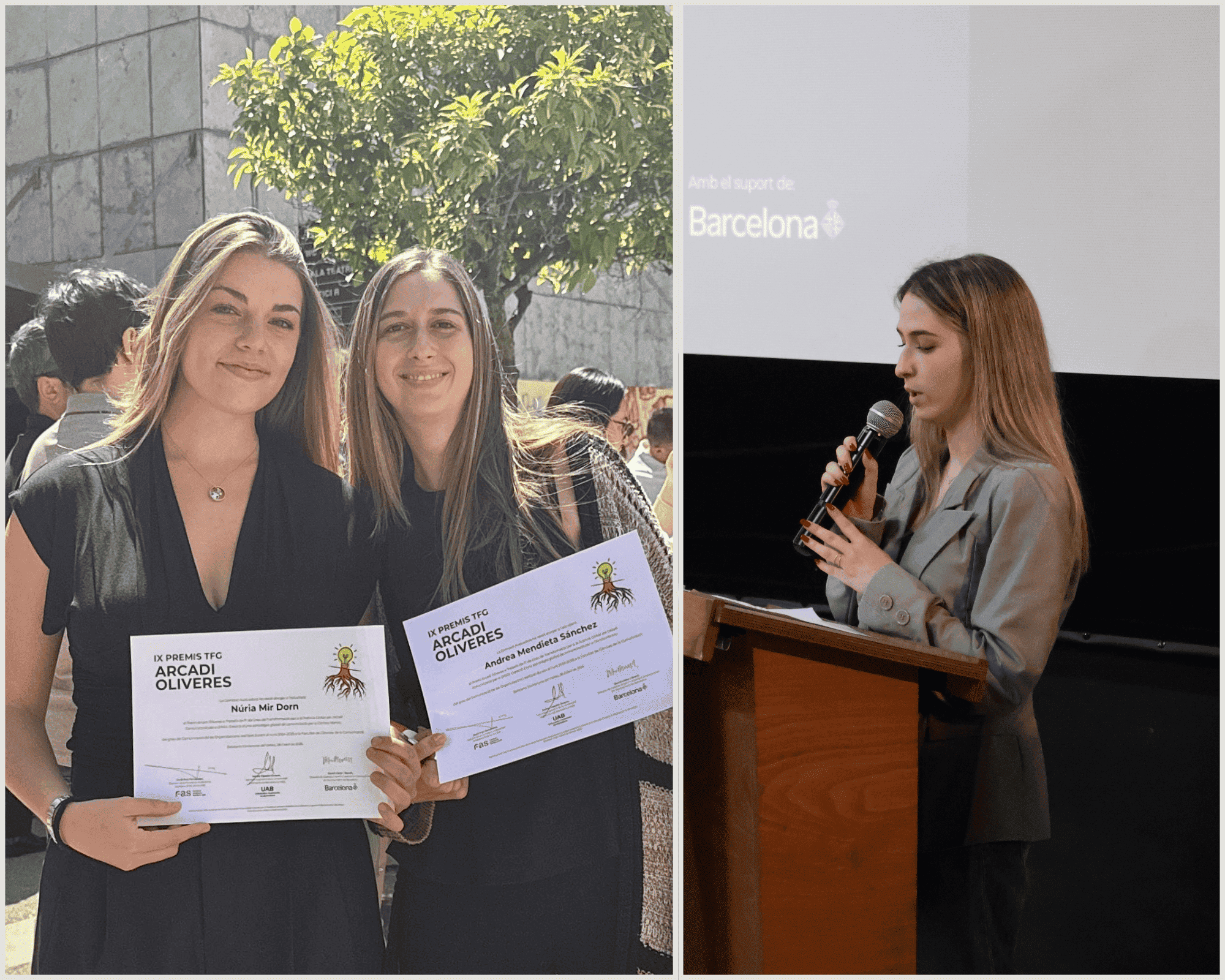
This recognition, promoted by the “Fundació Autònoma Solidària” with the support of the Barcelona City Council, aims to recognize students who have dedicated their Final Degree Project during the 2024-2025 academic year, to the development of research oriented to global justice.
With the aim of transmitting their commitment to global justice and fostering change, three students from the Faculty of Communication Sciences have been recognized for academic excellence and the high social impact of their final degree projects. First, Andrea Mendieta Sánchez and Núria Mir Dorn of the degree in Organization Communication with their project entitled “Communication for NGOs: Creation of a global communication strategy for Caritas Marroc”, with the mentoring of Amparo Huertas Bailén. On the other hand, the Ada Solà Conesa of the degree in Journalism with her project entitled “Voices at the front: the fight of war correspondents against gender inequalities”, with the tutoring of Santiago Tejedor Calvo.
In this interview, the students explain to us the motivations that led them to choose their TFG subjects, such as the process of research and creation of the project and the importance of communication as a tool for global justice.
1. To begin with, could you briefly explain what your awarded TFG consists of and what main topic does it address?
Andrea and Núria: Our TFG consists of the creation of a global communication strategy for Caritas Marroc, an NGO in the process of consolidation that, at that time, did not have a defined communicative structure.
The project is based on a real diagnosis on the ground and combines theoretical analysis with practical application. From this, we designed different lines of action and communication plans to help the organization improve its visibility, internal coherence and its ability to generate impact.
The main theme of the work is the role of communication as a strategic tool within the third sector, especially in contexts with few resources.
Ada: My TFG, entitled “Voices to the Front: the fight of war correspondents against gender inequalities”, analyzes how women journalists have come to terms with and worked in a historically masculinized field, such as war journalism.
The work focuses on the structural inequalities they have suffered, such as invi-sibilization, sexism or specific risks, such as aggressions, and also on how these correspondents provide a different, more human and transforming perspective in the coverage of conflicts.
2. The Arcadi Oliveres Awards focus on global justice. Why did you decide to orient your work towards this approach?
Andrea and Núria: From the beginning we understood that communication is not only a technical tool, but also a tool for social transformation.
Working with NGOs, we saw that many realities are not visible, not because they do not exist, but because they are not explained or reach the appropriate channels. That is why we wanted to focus work from global justice: because we believe that giving visibility to these realities is a way to reduce inequalities.
Our project is committed to ethical communication, not paternalistic, that puts people at the center and helps organizations to explain themselves with coherence and dignity.
Ada: Because my work not only talks about journalism, but about rights, desi-gualtat and power. War correspondents are at the intersection of multiple injustices: gender, professional and also geopolitical.
Making their situation visible is a way to denounce these global inequalities and to claim the right of women to occupy spaces of decision and take-up, especially in contexts as critical as armed conflicts.
3. How was the research and creation process of the TFG? Was there any major challenge you had to overcome?
Andrea and Núria: The process was very practical and closely linked to the terrain. We did not just stay in theoretical research, but worked directly with the team of Caritas Marroc, which allowed us to understand the real needs.
One of the main challenges was to adapt to a very different cultural, social and political context from ours. It was also a challenge to work with an organization that did not have a previous communicative structure, since it involved building from scratch.
In addition, we had to adapt the proposals to limited resources, which forced us to be very pragmatic and realistic.
Ada: It was a very intense process, especially in the field of documentation, because there is still little research with a gender perspective in this field. In addition, it was also demanding to manage the emotional burden of the issue, because we talked about violence, war and inequality.
Beyond the theoretical part, I gave a lot of weight to field work, especially through interviews. For me it was important to be able to approach this reality from the inside, listening directly to the voices of the correspondents. This involved a very active process of research and contact with professionals in the sector.
There were particularly shocking moments, such as interviewing journalists who were in conflict zones at the time. This makes you take a very direct awareness of the hardness of what they live and the importance of their faith.
And in this sense, I would also like to highlight and thank the generosity of all the correspondents who dedicated their time to participate in the work, because their contributions have been fundamental to give it meaning and depth.
4. What real impact do you think your work can have in society or in your professional field?
Andrea and Núria: We believe that our work can have an impact on two levels. On the one hand, within the organization, it helps to structure communication, improve its visibility and strengthen its ability to generate trust and attract resources.
On the other hand, the project also has a broader impact, since it proposes a model applicable to other NGOs with similar characteristics. The practical guide that we have developed can serve other organizations to improve their communication. In the end, we believe that improving the communication of an NGO is also a way to improve its social impact.
Ada: I think the main impact is visibility. The work gives name and voice to professionals who have been historically invisible, despite having a fundamental role in the coverage of conflicts.
But, beyond that, it also opens the door to rethinking journalism from a more inclusive perspective. That is, not only incorporate more women into the spaces of correspondentship, but also take into account their specific needs, which have often been ignored. Aspects related to health, physical conditions or safety in the field -which have not been contemplated because the professional model has been thought from a male perspective - are part of this reflection.
In this sense, the work not only denounces inequalities, but also plans the need to adapt professional structures so that they are truly equitable.
In the professional field, it can contribute to questioning dynamics still present in the sector and to promoting a more critical look. And, on a social scale, it helps to understand that the way we explain war is also conditioned by gender, and that incorporating other views can transform the story and make it more complete.
5. Was there any time during the project when you changed your perspective or discovered something you didn’t expect?
Andrea and Núria: Yes, absolutely. At first we see communication as a more technical tool, but during the project we understood that it is much more than that. Working on the ground and in contact with people, we saw that communicating is not only explaining what you do, but how you explain it and from what perspective.
We were also very shocked to see how many organizations do an incredible job, but they do not have the resources to communicate it, and this greatly conditions their impact.
Ada: More than a change of perspective, I would say that the work has reaffirmed me in the idea that it is a very necessary and little visible issue.
What I did discover, especially through interviews, were many realities that do not appear in the public narrative. As he spoke with correspondents, day-to-day issues arose that are rarely explained, but have a direct impact on his work.
For example, aspects linked to health and the body show important structural inequalities. Working conditions in conflict areas, both in logistics and security, are often thought from a male model that does not take into account the specific needs of women, which generates added difficulties and highlights a lack of real adaptation of the system.
This type of testimony led me to incorporate new lines of analysis that I had not initially planned, and that provide a more complete look at what it really means to be a war correspondent being a woman.
6. What role have the faculty and teachers played in the development of your work?
Andrea and Núria: The university has given us the theoretical basis and the tools to understand communication from a strategic point of view. In particular, the support of our tutor Amparo Huertas has been key to guiding the project, helping us structure it and making us reflect critically on what we were doing.
Ada: I have had a very close follow-up, which has allowed me to compare the different advances of the work and receive guidance in each phase.
7. How did you live when you received the prize? What does this recognition mean for you on a personal and academic level?
Andrea and Núria: It was a very exciting moment, especially because it is a recognition of a project in which we have been very involved, both professionally and personally. Beyond the prize itself, what it means for us is that value is given to a type of communication that is often not visible, but that is very necessary.
It is also a motivation to continue working in this line and continue to be linked to the third sector. In fact, we both currently live in Morocco, collaborating with different humanitarian organizations and NGOs, as communication and development advisors.
Ada: It was a very exciting moment. It is the culmination of many months of work, dedication and involvement.
On a personal level, I experience it as a recognition of all this effort, but also as a confirmation that it is worth investigating and giving voice to realities that are often invisible.
And at an academic level, it is especially significant because it highlights the imporance of working with a gender perspective and global justice within the field of communication. I believe that this type of research is not only necessary, but can also contribute to generating a more critical and transformative look.
8. For other students who are starting the TFG, what advice would you give them, especially if they want to do a work with social impact?
Andrea and Núria: We would tell them to try to get out of the theory and connect their work with a real reality. Working with an organization, understanding the context and seeing the impact of what they do makes the project much more meaningful. It is also important not to be afraid to adapt and change your mind if necessary, because in projects like this the process is as important as the result. And above all that anything can help, that as students we have a very valuable tool and we can use it to generate change and offer a service to entities or people who need it.
Ada: I would say that they choose a topic that really questions them, motivates them and gene-ri curiosity, because that is what keeps you involved throughout the process.
If they want to do a job with a social impact, it is important not to be afraid to look at reality critically and to give a voice to what is often not seen or explained sufficiently. It is also key to document yourself well and work rigorously, because the real impact comes from combining commitment with academic strength.
And, above all, that they dare to leave what is already said, to seek witnesses, to approach reality from first hand. In the end, the works that leave me-press are those that manage to connect knowledge and reality.