Urban street trees lose much of their capacity to cool during droughts
The combination of heat waves and drought markedly reduces the capacity of street trees to cool the air in Mediterranean cities. The lack of soil moisture severely restricts plant transpiration, reducing the thermal relief provided by these trees during extreme heat events.
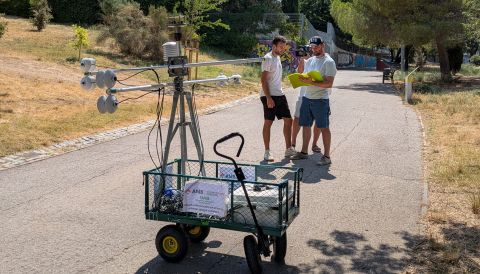
This is demonstrated by a research published in the scientific journal Urban Climate and developed by ICTA-UAB, which analyses the behaviour of street trees in dense streets of Barcelona during intense heat episodes. The goal was to determine how soil moisture and plant canopy interact in mitigating urban heat.
Under ideal soil moisture conditions, plant transpiration reduces air temperatures by an average of 1.2 °C to 1.7 °C during midday/mid-afternoon hours, allowing a reduction in heat stress experienced by pedestrians - measured with the Universal Thermal Climate Index (UTCI) - by up to 3.2 °C, and decreasing mean radiant temperature (that perceived by pedestrians from solar and asphalt radiation) by up to 12.3 °C in areas most exposed to the sun. However, when extreme heat coincides with drought periods, the lack of water forces trees to close their stomata to prevent dehydration, severely impairing or eliminating evaporative air cooling.
It is in this context of dry soil where crown shading plays a key role as a refuge. Despite the loss of evaporative air cooling, direct solar radiation blocking by the foliage prevents overheating of asphalt and facades, as well as direct solar exposure on pedestrians beneath the trees, retaining between 71% and 97% of its protective cooling effect on pedestrian thermal comfort.
Thus, the study determines that urban greening planning strategies must adapt to the new climatic reality of the Mediterranean. To maximise tree effectiveness, the authors recommend prioritising evergreen species and/or drought-tolerant deciduous species that sustain canopy structure during summer months. Likewise, strategic irrigation should be ensured during heat peaks for deciduous species that retain their foliage in summer, as well as preserving soil moisture in tree pits and pervious soil.
According to the author: “One of the main challenges facing the city is ensuring that trees maintain sufficient foliage during drought periods, and especially during heat waves, which is precisely when shade is needed the most.”
The research, led by researcher Ricard Segura, was conducted using the modified BEP-Tree meteorological model, adapted to assess heat exchanges at street scale and validated with field micrometeorological measurements in the Metropolitan Area of Barcelona. The work was developed at ICTA-UAB under the umbrella of the URBAG project, funded by the European Research Council (ERC) and led by researcher Gara Villalba.
Reference article: Segura-Barrero, R., et al. (2026). The role of soil moisture and shading in influencing the capacity of urban street trees to reduce heat stress. Urban Climate, vol. 68, 103086. DOI: 10.1016/j.uclim.2026.103086