
Virtual reality in the 17th-19th centuries
Literary and optical techniques were essential for the construction and circulation of knowledge in the 17th-19th centuries. Under the provocative idea that these were “immersive techniques”, Ilaria Ampollini recently gave a seminar at the UAB's Institut d’Història de la Ciència (iHC) entitled “What do we mean by ‘immersive techniques’? A historical perspective on virtual witness and the circulation of knowledge (17th-19th centuries)”.
Ilaria Ampollini, associate professor of History of Science at the University of Ferrara, is researcher in the history of science whose fields of research focus on studying how the moment of communication (both from expert to expert, and from expert to layman) intertwines with the process of creating knowledge itself. The main topics she has worked on revolve around three cores: comet movements and risk and probability communication in 18th century France; educational science games in Victorian and Georgian London; and, finally, the one most relevant to the seminar, immersive techniques and the circulation of knowledge from 1650 to 1900 in France and Britain.
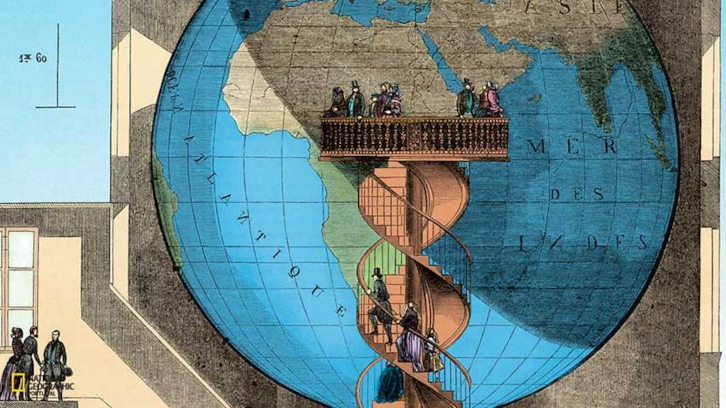
Ampollini began by defining immersive techniques as "those rhetorical, visual and multimedia strategies that construct alternative realities around readers or observers, transporting them beyond their present reality". These immersive techniques are divided into three types: literary, texts with realistic descriptions that that enable readers to imagine the content vividly; optical, such as a portable camera obscura or kaleidoscope; and, finally, multimedia, referring to 360-degree spaces where the whole body experiences the immersion, such as the Globe Céleste. The seminar was focused on literary and optical techniques.
Literary techniques: the role of images in the construction of knowledge
The first literary technique that the author focused on can be found in the book New Experiments Physico-Mechanicall, Touching the Spring of the Air, and its Effects (Made, for the Most Part, in a New Pneumatical Engine) by Robert Boyle, from which Ampollini takes the images of the text as an object of study. Her way of working historiographically is inspired by the book by Shapin and Schaffer, Leviathan and the AirPump. From it, she takes the idea that “matters of fact” are constructed, i. e., at the heart of knowledge production there are aspects of the communication of this knowledge and that this communication configures the knowledge produced in itself (Shapin, 1984).
The historian argued that it is not enough to study the arguments that Boyle uses to convince people of the "truths" he is demonstrating, but that images are as important. For her, these images not only support the argumentation but are an immersive technique that aims to simulate the experiment to the reader so that they end up completely convinced.
Another example she exhibited is from Thomas Baldwin's 1786 book Airopaidia. Baldwin would fly in hot air balloons, an inaccessible activity for most people of the time, and wanted to show that hot air balloons were a useful way to scientifically explore the properties of air. Baldwin wanted to convince people of the importance of these flights to receive funding. Ampollini highlights that he describes his flights with high precision and explains that he does so to provide the reader with an image of what he himself sees. That is why the book not only includes illustrations of what he is viewing during the flights, but also contains instructions on how to look at them. The fact that Baldwin wrote down a concrete way of looking at his figures shows that he wanted to create an immersive effect on his readers.
The rapporteur argued that these images, illustrations and detailed descriptions served to model the knowledge society receives and how it is perceived. Scientists used them to build a common knowledge base without the need of having each person check out all the “matters of fact”.
Optical techniques: the role of objects in the dissemination of knowledge
Ampollini considers that optical techniques are connected to the circulation of knowledge in two different ways: firstly, because they were normally built to enable scientific experiments, such as the telescope or the microscope; secondly, they were also used for the dissemination and expansion of the knowledge produced.
In the seminar, the science historian explained how her research is based on three types of optical immersive techniques: the portable camera obscura, the microscope, and the kaleidoscope. These three machines show a reality that already exists, the world one sees when looking through any of them is not artificially produced, but it is favourable for the development of scientific knowledge.
In the case of the microscope, Ampollini explained that it is immersive since "you have to concentrate your senses only on what you can see and because, in that period, there was this idea that the microscope showed a world that until then had been hidden". With this, the scientist made it clear that the invention had shaped the society of the time.
The same historiographic approach can be applied to the kaleidoscope, as she explained how the kaleidoscope relates to the circulation of knowledge because its creator could only build it thanks to his understanding of light and optics. At the same time, she emphasised the popularity of the machine's distribution.
Ilara Ampollini closed the seminar with a reflection in which she remarked that the monograph resulting from this research does not pretend to be a book where the prehistory of immersive techniques is explained. It rather aims to demonstrate that immersion was key in the sharing of scientific knowledge from the beginning of modern science, and in achieving the ultimate intention of scientists: the public sharing their points of view.
The seminar culminated in a participatory debate with the audience, who questioned the intellectual gesture and brought to the table the possibility of studying each immersive technique differently, so as to be able to pinpoint the specific contributions each one makes to the history of science.
Unit of Comunication
Universitat Autònoma de Barcelona
References
Ampollini, I. (sense data). ILARIA AMPOLLINI - Curriculum Vitae. Recollit de Academia: https://unimi.academia.edu/ILARIAAMPOLLINI/CurriculumVitae
Ampollini, I. (sense data). Ilaria Ampollini Curriculum. Recollit de Università degli Studi di Ferrara: https://docente.unife.it/ilaria.ampollini/curr
Baldwin, T. (1786). Airopaidia: containing the narrative of a Balloon Excursion. Londres.
Shapin, S. (1984). Pump and circumstance: Robert Boyle's literary technology. Social studies of science, 14 (4), 481-520.
Shapin, S., & Schaffer, S. (2011). Leviathan and the air-pump: Hobbes, Boyle, and the experimental life. Princeton University Press.