
Co-creating Virtual Reality Videos on Accessibility: The Mediaverse Project Experience
With the development of new technologies such as virtual reality, new challenges and communication opportunities have appeared. In this context, the UAB TransMedia Catalonia research group contributed to a platform to create immersive content, and several very different groups worked to co-create more accessible content with a social and educational perspective.
Mediaverse was a European project in which the research group TransMedia Catalonia participated from 2020 to 2025. A platform with a range of tools for creating immersive content was developed within the project. Some partners used this platform for citizen journalism experiences, while others employed it for artistic experiences. In our case, we sought to leverage the platform to co-create 360-degree immersive videos with a social or educational impact. Given that our research group works in the field of accessible communication (see our website), accessibility was one of the project’s core themes.
The article referenced at the end of this text presents the co-creation processes carried out within the Mediaverse project and explores the potential of immersive videos. In a first phase, co-creation activities were conducted with:
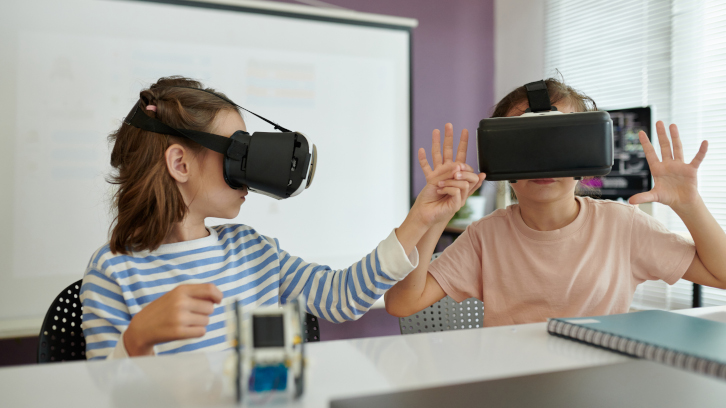
- Children from the UAB’s CROMA programme, who co-created a video about their school while becoming aware of audio description, subtitling, and sign language interpreting as access services.
- Young people from the UAB’s ITACA programme, who developed accessible 360-degree TikTok videos.
- Staff from SOM Fundació, an association of people with intellectual disabilities, who created a virtual tour of their facilities as well as an immersive video to support people’s autonomy when shopping in a supermarket.
- Students of Occupational Therapy at the EUIT, who created multiple videos, such as an experience aimed at reducing anxiety or a video of places older adults with reduced mobility had visited in their childhood.
In a second phase, co-creation continued with:
- Staff from ACAPPS, an association of people with hearing loss, who created a virtual tour of their headquarters.
- Teenagers from Manuel Carrasco secondary school, who developed a Christmas concert and a virtual exhibition on the Holocaust as part of their History course.
- Students from the School of Audiovisual Media EMAV, who produced a short fiction film.
- An independent dancer who generated audio descriptions for artistic content.
- Students from the EUIT BA in Occupational Therapy, who continued co-creating content responding to the needs of diverse users.
- Young people from the UAB’s ITACA programme.
These experiences allowed us to observe that immersive technologies have significant potential in educational and social settings: young people enjoy creating this type of content, and older adults with reduced mobility are deeply moved when reliving experiences. Nevertheless, technological challenges remain considerable, and further simplification of the tools is required. In the article we present both quantitative and qualitative evaluation data.
We also learned that co-creation processes are not uniform: each context requires a different approach as well as ongoing support. A single model cannot be applied across all cases.
Finally, we were able to demonstrate that virtual reality has great potential for raising awareness of accessibility among diverse audiences. For example, by the end of the experience, the children from the CROMA programme had developed a strong understanding of different accessibility services—such as subtitling, audio description, and sign language interpreting—and were able to apply them within their school environment (see related news).
For further information about the project, please visit the website: https://mediaverse-project.eu/
TransMedia Catalonia, AccessCat
Department of Translation, Interpreting and East Asian Studies
Universitat Autònoma de Barcelona
References
Matamala, A. Co-creating 360-degree videos with a social and educational approach: the mediaverse experiences. Univ Access Inf Soc 25, 7 (2026). https://doi.org/10.1007/s10209-025-01276-6. https://ddd.uab.cat/record/323951.