Francisca Bustamante’s Thesis Defense
Horizontes de posibilidad en el acceso a la educación superior: admisión meritocrática, elecciones condicionadas e intersecciones de desigualdad
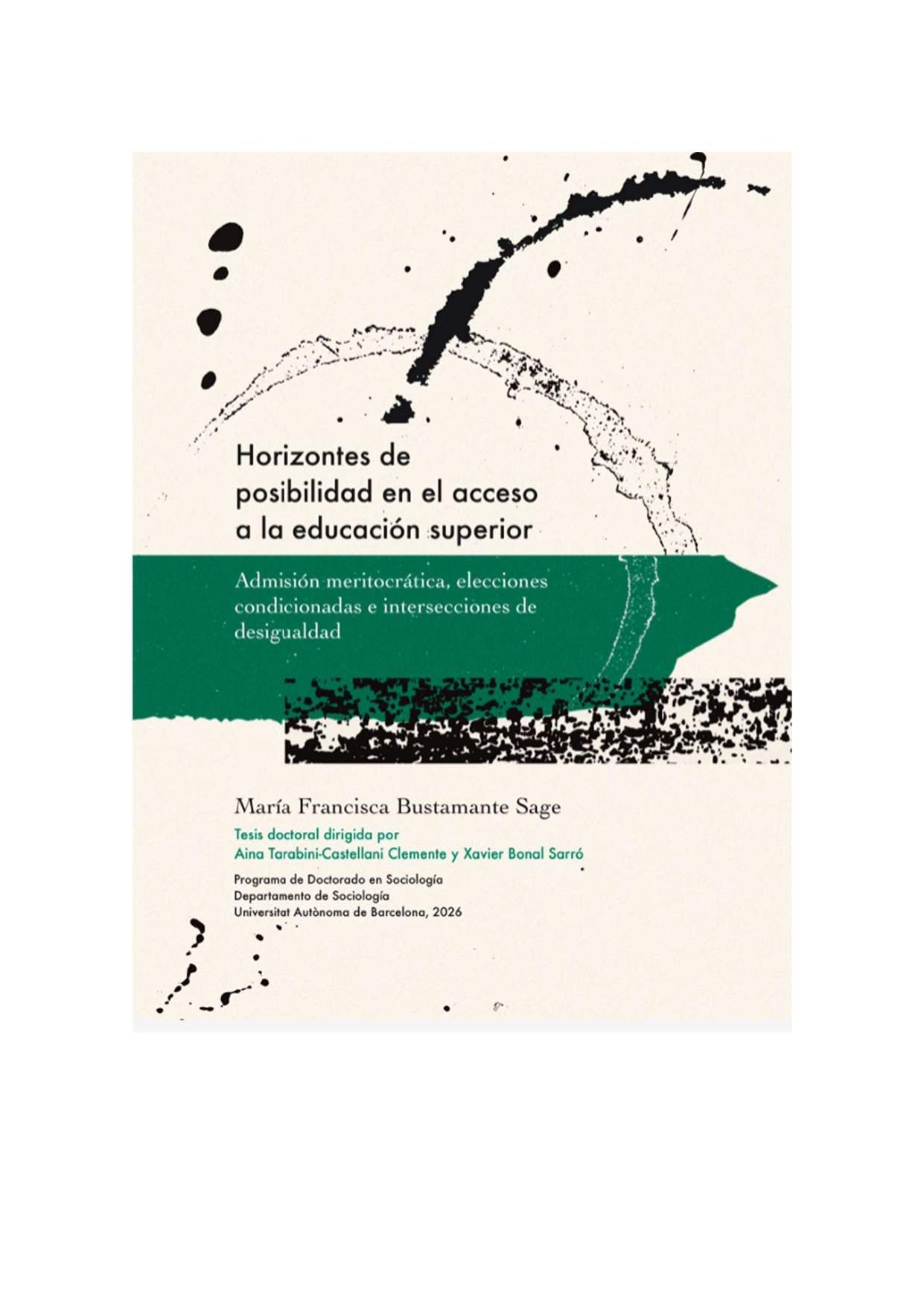
The global expansion of higher education has not necessarily implied a reduction in inequalities in access to this level of education. Merit-based admission systems can reproduce vertical access barriers, linked to the availability of places and entry conditions, or deepen horizontal gaps associated with hierarchies of prestige and quality among institutions and programmes. In response, admission systems have incorporated mechanisms aimed at reducing access gaps, grounded in diverse conceptions of social justice. In 2010, Ecuador implemented a reform establishing a unified state admission system at the national level, combining a meritocratic criterion based on a standardised examination with an affirmative action policy aimed at supporting access for historically excluded groups. This doctoral thesis analyses how vertical and horizontal inequalities are configured under this system, with emphasis on the ways in which socioeconomic origin and other forms of social inequality shape admission scores and educational choices.The thesis is developed through a mixed-methods design. In the quantitative phase, national data from higher education applications for the first semester of 2020 (68,479 cases) are analysed using binary logistic regression models. The results show that various conditions of social and educational disadvantage determine lower admission scores and lower probabilities of choosing highly selective programmes and institutions, regardless of the score obtained, including among affirmative action beneficiaries with high entry scores.Building on these findings, the qualitative phase explores in depth the construction and meaning of choices between high- and low-selectivity programmes. Twenty-six semi-structured interviews were conducted with students who are beneficiaries of the affirmative action policy and hold high entry scores, at a public Ecuadorian university with broad social recognition and an academic offer spanning different levels of selectivity.The qualitative results show that choices are shaped by the interaction between structural, systemic, relational, and personal-biographical conditioning factors, crosscut by the intersections of social class, gender, and ethnicity. These conditioning factors enable or constrain horizons of action and give rise to four logics articulated around different orientations towards perceived risk and the future, which contribute to understanding why students with similar academic performance opt for programmes of different selectivity levels: a maximising logic, oriented towards accessing the most prestigious and selective options; an access assurance logic, which leads students to forgo their preferred programme and opt for less selective alternatives; a social interest logic, which justifies choices on the basis of commitment to social contribution, displacing criteria of prestige or selectivity; and a certainty of entry logic, which legitimises decisions on the basis of affinity for the programme and coherence with one's own abilities, rather than leveraging the score to access more selective options.Ultimately, the results call into question the linear association between academic merit and access to the most selective options, and contribute to the discussion of the ways in which merit-based admission systems and individualised conceptions of choice are associated with the reproduction of inequalities in access to higher education. At the same time, they contribute to reflection on access policies and the conceptions of social justice that underpin them, highlighting the importance of developing policies that recognise students' needs and support their transition processes into higher education.
Date: 28/10/2026
Schedule: 15:30h
Place: Sala de graus.
Facultat de Ciències Polítiques i Sociología