Doctoral thesis defense of Fernando San Antonio
El vegetarianismo como una práctica regida por normas. Una propuesta teórica y dos estudios empíricos.
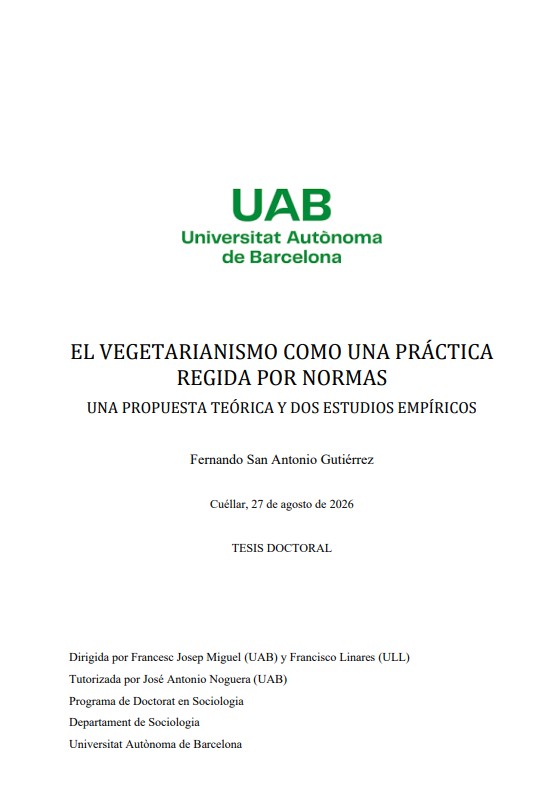
The thesis has two main objectives. The first is to establish an analytical framework for the study of vegetarianism as a norm-governed social practice. The second, empirical in nature, is to analyse how the elements of the main contemporary definitions of social norms affect the following of the regulative rule of vegetarianism: "Do not eat animals (or their derivatives)".The thesis is divided into two parts, in addition to the introduction and conclusion sections. The first part (chapters II to IV) reviews the main theories of social norms and institutions proposed since the mid-twentieth century (Chapter II) and examines the most important contributions of the social sciences that have treated vegetarianism as an object of study (Chapter III). As a result of this analysis, the Rules and Equilibria Theory (RaET), proposed by Frank Hindriks, is presented as the most promising theoretical framework for studying vegetarianism. Thus, the first part concludes with the construction of a theoretical model based on RaET (Chapter IV) to understand vegetarianism as a norm-governed social practice, and it provides an empirical analysis of the phenomenon of deviation from the vegetarian norm and related elements of this behaviour.The second part (chapters V to VII) is intended to answer the research question: Is the rule "Do not eat animals (or their derivatives)" a social norm among vegetarians? Chapter V begins by presenting two survey studies carried out for the purposes of the thesis. Chapter VI presents Study 1, that was carried out in Catalonia, with a sample of 308 subjects composed of two groups, sample-balanced in both their size and in the variables of gender, age and social class: one composed of people who follow a vegetarian diet and the other of people who do not. In this study, different variables related to social norms are explored. However, the primary variable of interest concerns whether the animal source of foods unsuitable for vegetarians affects the intention to deviate from the rule "Do not eat animals (or their derivatives).". In addition, some variables are included to compare the perception of one's own and others' eating habits across the groups.Study 2 focuses specifically on the elements present in Hindriks' definition of norm-governed social practice: empirical expectations, normative and sanction expectations, normative beliefs, and acceptance of the rule on which the norm is based. In this case, the sample consisted of 500 vegetarians from across Spain, who answered an experimental vignette question to measure the potential influence of the aforementioned elements on the intention to deviate from the rule "Do not eat animals (or their derivatives)".The main results of the thesis are the following. First, empirical and normative expectations about deviating from the vegetarian norm do not seem to affect one's intention to do so within the vegetarian population. Second, the perception of inadequacy associated with deviation from the vegetarian norm—normative beliefs—is confirmed as the main indicator of compliance with it. Likewise, the type of animal from which the products considered unsuitable come is a relevant factor in the intention to deviate from the vegetarian norm. Finally, the analytical framework of Hindriks' Rules and Equilibria Theory has proved especially useful for analysing phenomena related to vegetarianism, understood as a norm-governed social practice.
Date: 23/10/2026
Schedule: 12h
Place: Sala de Graus
B3BIS/-121
Fac. Ciències Polítiques i Sociologia