A PhD experience: Dr. Claudia Cano
"For these questions to be explored and transformed into knowledge, a structure that ensures stability, support, and continuity is essential."
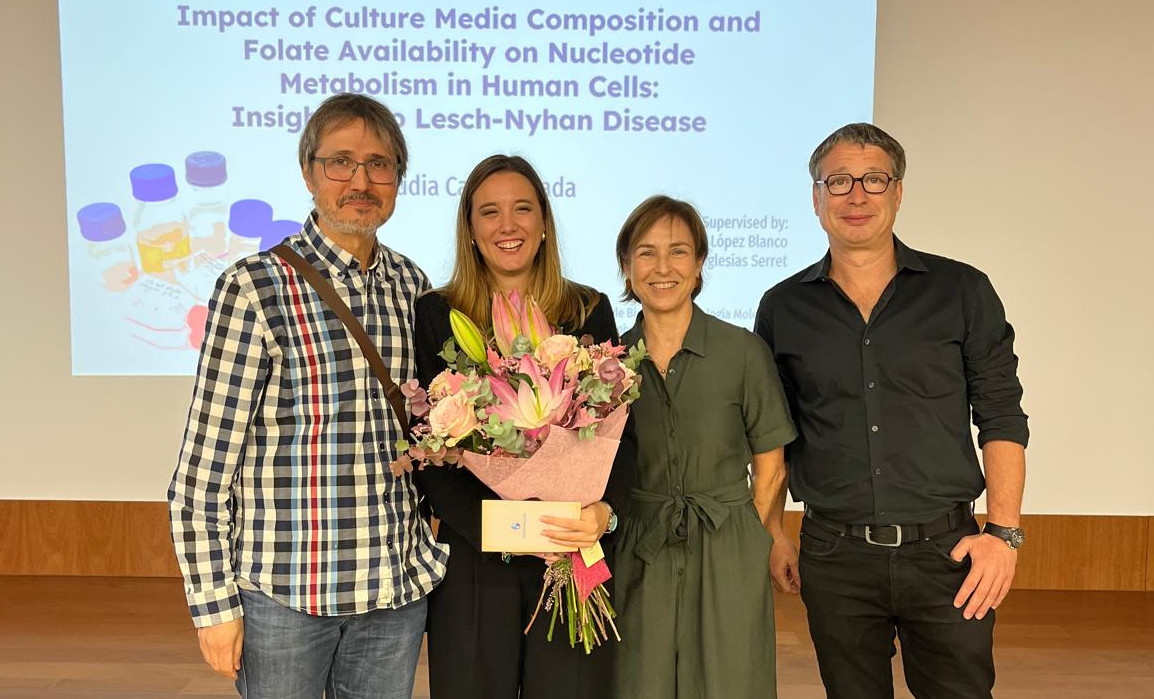
Rare diseases are those that affect fewer than 1 in every 2,000 people. Although individually uncommon, there are nearly 7,000 rare diseases which collectively affect 7% of the global population (more than 36 million people in Europe alone).
One of these is Lesch-Nyhan disease, an X-linked recessive genetic disorder caused by the complete deficiency of the enzyme hypoxanthine-guanine phosphoribosyltransferase (HPRT). This enzyme is part of the purine salvage pathway and enables cells to use free bases such as guanine or hypoxanthine to generate essential nucleotides. In the absence of HPRT, cells lose their main recycling mechanism and rely exclusively on de novo purine synthesis.
Although Lesch-Nyhan disease is a metabolic disorder, patients exhibit severe neurological symptoms, including dystonia, spasticity, cognitive developmental impairment, and self-injurious behaviors. The exact relationship between HPRT deficiency and the neurological symptoms is still not fully understood.
The study of rare neurological diseases presents major challenges, such as the impossibility of studying neurodevelopment directly in patients and the scarcity of biological samples. For this reason, we rely on experimental models. However, HPRT-deficient animal models do not reproduce the key neurological symptoms observed in humans, and patient-derived cells seem to behave similarly to control cells under standard culture conditions. This led us to question whether these standard conditions are truly comparable to those in a living organism. The answer is no.
Conventional culture media, despite being refined over time, contain non-physiological concentrations of several components: excess amounts of certain nutrients and a lack of important metabolites. A key example is folic acid, an essential vitamin for de novo purine synthesis, which is the only source of these nucleotides in patients with Lesch-Nyhan disease. Previous studies from our group demonstrated that reducing folic acid concentration in the medium from conventional levels (2200 nM) to physiological levels (25 nM) reveals alterations in patient-derived fibroblasts that are not observed under standard conditions.
Based on this premise, my thesis began by analysing how physiological levels of folic acid could alter purine synthesis in various cancer cell lines. We observed interesting results: physiological folic acid conditions can alter the metabolism of some cell lines such as HEK293T, Jurkat, or A549, leading to the accumulation of ZMP (an intermediate of the de novo purine synthesis pathway), as previously seen in fibroblasts. In contrast, other cell lines such as HeLa or EHEB did not accumulate ZMP, indicating a lower dependence on this pathway.
These findings led us to use Plasmax-PV, a medium whose nutrient profile reproduces physiological concentrations of nutrients and vitamins. Using this medium allowed us to determine that the de novo purine pathway is particularly sensitive in lymphocytes under physiological conditions. As a consequence, we observed that tumour T lymphocytes (Jurkat cells) show increased sensitivity to methotrexate (an antifolate used to treat leukaemia and rheumatoid arthritis) when cultured under physiological conditions. This discovery opens the possibility of developing more effective therapies with better-adjusted doses, thereby reducing adverse effects associated with overtreatment.
The last part of our study focused on applying these physiological media to cellular models of Lesch-Nyhan disease. We observed that Plasmax-PV induces ZMP accumulation in patient-derived fibroblasts but not in controls, and increases the levels of folic acid transporters, suggesting a functional adaptation of these cells.
Looking ahead, the objective is to study neurodevelopment in control and patient-derived cells under physiological conditions, in order to determine whether vitamin and metabolite concentrations play a relevant role in this process—an aspect that has gone unnoticed until now. During my stay in Dr. H.A. Jinnah’s laboratory (Emory University), and with the guidance of Diane Sutcliffe, I learned how to culture, expand, and characterise patient-derived induced pluripotent stem cells (iPSCs), and how to differentiate them into neural stem cells (NSCs). This experience allowed our laboratory at the UAB to culture iPSCs and differentiate them into NSCs under standard conditions, and to verify that these cells can be maintained in vitro with physiological folic acid levels while preserving their differentiation markers.
All these advances open new questions, and that is precisely the essence of science: a path in which each answer illuminates new unknowns. Perhaps the next time we place our cells in a Petri dish, we should ask ourselves whether the conditions we take for granted truly reflect their natural environment. This constant search for a deeper understanding of what we study is what drives scientific progress.
However, such progress does not rely solely on curiosity or dedication. For these questions to be explored and transformed into knowledge, a structure that ensures stability, support, and continuity is essential. And this is where reality becomes more complex. Science in Spain continues to be marked by unstable calls for funding, a lack of sustained investment, and professional trajectories that are difficult to consolidate. Without the necessary time, resources, and security, ideas with great potential stagnate and teams built over years disperse. Investing in science means investing in the people who make it possible and ensuring conditions that allow them to build long-term careers and produce valuable knowledge for society.
Perhaps that is why, looking back, I realise that as important as the scientific results have been the people who have accompanied me along this path. Beyond the professional learning that this thesis has given me, I take with me the guidance of Dr. José Manuel López and Dr. Daniel Iglesias Serret, who have supported and guided me; the companionship and inspiration of Dr. Paula Escudero and Neus Ontiveros; and the closeness of my fellow PhD students in the unit, with whom we have built a network that has sustained us through both good days and difficult ones. A thesis is a world, but that world is only built thanks to those who share it with you.
Dr. Claudia Cano Estrada