A hundred students from three educational centers participate in the 4th Reporters Channel Day 2026
Last Friday, May 8, the Faculty of Communication Sciences of the UAB hosted the IV Canal de Reporters Conference, promoted by the Department of Education and Vocational Training of the Generalitat de Catalunya with the simultaneous collaboration of eight Catalan universities.
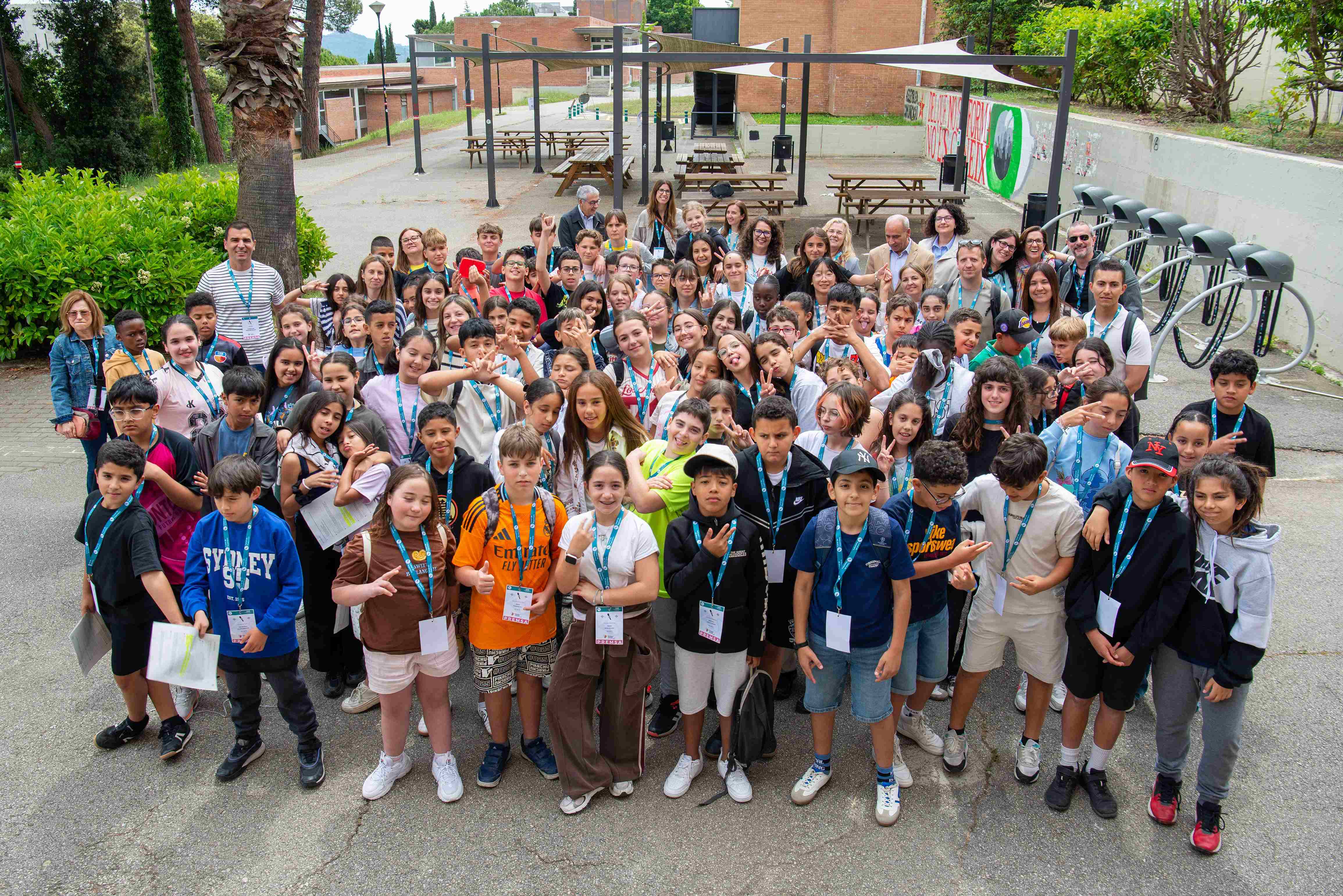
The day, in which a hundred primary and secondary students from three different educational centers participated, the Cifuentes School in Sabadell, the El Turó School in Montcada i Reixac and the Josefina Ib laez School in Abrera, was carried out with the aim of claiming the importance of school journalism as a participatory task that, apart from promoting critical thinking of students, can also become a service tool to document projects to improve their immediate environment.
In this edition, the focus is on social commitment, volunteering and the promotion of media literacy that, as Ignasi Giménez Renom, the Secretary for Educational Improvement of the Generalitat de Catalunya mentioned: “In the current context, in which new forms of communication are becoming increasingly important, we must provide our students with the appropriate tools and instruments to make known what the work of correctly informing themselves and making good news means. That is why initiatives such as the Reporters Channel are absolutely essential today.”.
The event began with an institutional welcome by the dean of the Faculty of Communication Sciences, Juan José Perona. He emphasized the role of the faculty in this project, since the Autonomous University of Barcelona is a pioneer in hosting it in its facilities. Next, Ignasi Giménez Renom intervened, who shared a reflection with the students on what it means to be journalists and the importance of the Canal de Reporters project, because it teaches them to do true journalism. Finally, Dr. Laura Santamaria Guinot, vice-rector for Culture and Language Policy at the UAB, gave a brief explanation to the students about the importance of the various organized workshops.
Participants had the opportunity to carry out practical workshops related to media and information literacy. They visited the faculty's set to learn about the characteristics of audiovisual production, as well as radio studios to record a program. In addition, they also learned what are the main risks that can be found on the net in the two media education workshops they carried out, where they were offered tools to know how to face these risks and promote a more responsible consumption of information.
The Reporters Channel project consists of an initiative promoted by the Area of Educational Technology and Responsible Digitalization of the Department of Education and Vocational Training, which was launched in 2021 with the aim of promoting the creation of journalistic content by students and enhancing their digital and communicative skills.
The IV Canal de Reporters Conference was held simultaneously in eight other Catalan universities, bringing together 800 students from 32 educational centers throughout the Catalan territory. The eight faculties that have offered their spaces to host the day are the Faculty of Communication Sciences of the Autonomous University of Barcelona, the Faculty of Tourism of the University of Girona, the Faculty of Letters of the University of Lleida, the Faculty of Business and Communication of the University of Vic - Central University of Catalonia, the TecnoCampus of Mataró, the Faculty of Letters of the Rovira i Virgili University of Tarragona, the Poblenou Campus of the Pompeu Fabra University Barcelona and the Faculty of Information and Audiovisual Media of the University of Barcelona.
The eduCAC Programme, the Association of Journalists of Catalonia and the Cybersecurity Agency of Catalonia and Verificat are the entities that have participated in the creation and development of workshops on network security and information verification.
In this way, the 4th Reporters Channel Day is added to the commemoration of the year 2026 as the International Year of Volunteering, established by UNESCO. Thus, we want to promote an active attitude and a constructive approach, in which participating and explaining what happens in our communities is a way to improve the world among all.