Joan Deus Presents Advances in Neuroimaging Research on Fibromyalgia at the 52nd National Congress of the Spanish Society of Rheumatology
The researcher from the Department of Clinical and Health Psychology presented a review of more than two decades of research on neuroimaging and chronic pain, highlighting the potential of brain biomarkers to improve the diagnosis and treatment of fibromyalgia.
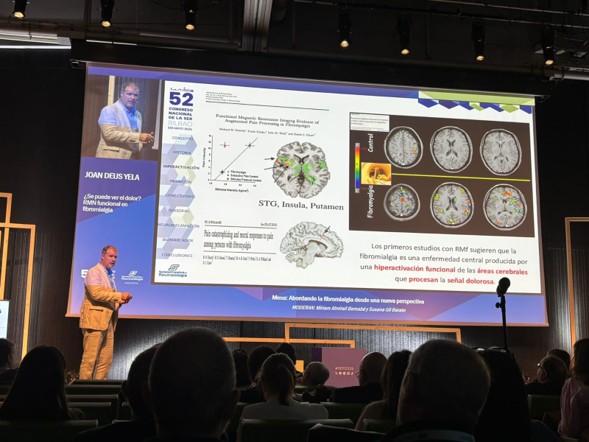
Joan Deus, Professor in the Department of Clinical and Health Psychology at the Universitat Autònoma de Barcelona and expert at the Magnetic Resonance Research Unit of Hospital del Mar, participated in the 52nd National Congress of the Spanish Society of Rheumatology (SER), held in Bilbao, where he delivered the lecture “Can We See Pain? Functional MRI in Fibromyalgia.” His presentation was part of the symposium “Approaching Fibromyalgia from a New Perspective” and was among the highest-rated sessions by attendees, receiving a score of 4.66 out of 5, above the average rating for the symposium.
During his presentation, Joan Deus reviewed more than two decades of neuroimaging research in fibromyalgia, highlighting how advances in functional magnetic resonance imaging, brain connectivity, neuroinflammation, and artificial intelligence have contributed to a better understanding of the neurobiological mechanisms underlying chronic pain. The lecture traced the evolution of scientific knowledge from the first studies identifying patterns of brain hyperactivation in people with fibromyalgia to the most recent research aimed at developing potential objective biomarkers for diagnosis and prediction of treatment response.
One of the central messages of the presentation was that fibromyalgia is currently understood as a nociplastic pain disorder, characterized by alterations in central pain processing. Evidence accumulated through neuroimaging techniques has revealed functional and structural changes in brain networks involved in sensory perception, emotional regulation, and endogenous pain inhibition, as well as neuroinflammatory processes that may help explain the persistence of symptoms.
The presentation also emphasized how these findings are beginning to translate into clinical practice. Among the emerging strategies discussed were several non-invasive neuromodulation techniques capable of targeting brain circuits involved in pain processing. On the one hand, nocturnal vibrotactile stimulation, developed and evaluated by international research groups that include Joan Deus's team—an area in which the group has been a pioneer and leading contributor—has shown promising results in reducing fatigue and pain in people with fibromyalgia. On the other hand, magnetic or electrical stimulation of the primary motor cortex has demonstrated the ability to modulate central inhibitory pain networks and reduce disease-related symptoms.
These advances are particularly relevant for Clinical and Health Psychology, as they expand the range of available tools for the comprehensive management of fibromyalgia and create new opportunities for integration with evidence-based psychological interventions, including third-wave therapies and other treatment programs focused on adaptation to chronic pain.
In conclusion, Joan Deus highlighted that neuroimaging is progressively transforming pain—traditionally considered a subjective experience—into a phenomenon that can be measured and characterized through objective brain markers. The combination of advanced neuroimaging techniques and artificial intelligence models is opening new avenues for the development of diagnostic and prognostic tools that may contribute to more personalized care for people living with fibromyalgia. As summarized in the presentation itself, the field is moving “from interpreting pain to measuring it.”