The Research Group on Eating and Weight-Related Problems participates in the 33rd European Congress on Obesity (ECO 2026)
The team presents three studies linking weight stigma with mental health problems in adolescents and healthcare professionals.
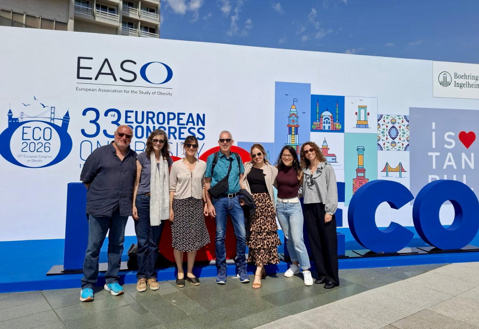
The research group “Eating and Weight-Related Problems” (PRAP), led by Dr. David Sánchez-Carracedo from the Department of Clinical and Health Psychology at UAB, in collaboration with other national and international researchers, participated in the 33rd European Congress on Obesity (ECO 2026), held in Istanbul (Turkey) from May 11 to 15, 2026.
ECO 2026, organized by the European Association for the Study of Obesity (EASO), is the leading scientific meeting in Europe for sharing major advances in obesity research and treatment. During the event, the PRAP team presented several lines of work focused on the psychological impact of weight stigma.
As part of the group’s latest funded research project, a prospective longitudinal study on the impact of weight stigma on adolescents’ psychological well-being, two studies were presented. The first was delivered as an oral communication by Associate Professor Dr. Dimitra Anastasiadou, presenting results from the study “Longitudinal Analysis of Exposure Trajectories to Family-Based Weight Stigma and its Impact on Adolescent Psychological Well-being”, which examines how weight stigma in the family environment, whether recent or cumulative, predicts deterioration in adolescents’ mental health
The second was presented by predoctoral researcher Clara Almazán with the study “Weight Bias Internalization as a Prospective Predictor of Disordered Eating and Unhealthy Weight Control Behaviors in Adolescents”. The study shows that higher internalization of weight stigma (WBI) prospectively predicts an increase in disordered eating attitudes, binge-eating episodes, and a higher risk of unhealthy weight-control behaviors over a two-year period. The main conclusion identifies WBI as a key and priority long-term target for prevention programs aimed at adolescents, especially among girls.
Finally, predoctoral researcher Paula Sozza presented an international collaboration with experts from Brazil, involving Dr. Eva Penelo (Department of Psychobiology and Methodology in Health Sciences) and Dr. David Sánchez-Carracedo, titled “Healthcare professionals also experience weight stigma: evidence on lived stigmatizing experiences in Brazil”. The study highlights that weight stigma is a frequent and normalized experience among healthcare professionals themselves, often manifested in the form of teasing and workplace discrimination. The research concludes that this reality must be recognized in order to promote safer and more inclusive work environments through interventions that integrate both patient and healthcare staff experiences.
These contributions add to global knowledge on weight stigma, which has so far been mainly focused on Anglo-Saxon populations, and reinforce the importance of designing preventive strategies that prioritize psychological well-being and healthy lifestyles rather than weight control, as well as reducing weight stigma across different contexts.