
TRAMPOLINe-: A European programme to drive the industrial adoption of bioelectrochemical technologies
The European project TRAMPOLINe-, coordinated by the Universitat Autònoma de Barcelona (UAB), promotes an international programme aimed at bringing bioelectrochemical technologies closer to industrial application. These technologies, which combine biological and electrochemical processes, have shown very promising results in recent years at laboratory scale and the time has come to assess their performance at larger scales. The main objective of TRAMPOLINe- is to train a new generation of researchers capable of bridging fundamental research with the needs of the industrial sector, while developing sustainable solutions to reduce pollution, optimise resource use and advance towards a circular economy.
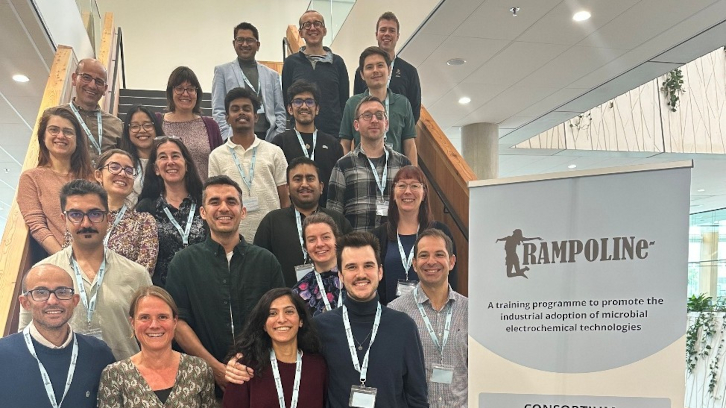
The 10 doctoral candidates involved in the programme, co-supervised by different institutions, are working on the development of technologies based on bioelectrochemical processes, with a particular focus on bioremediation, desalination, industrial bioproduction, resource recovery and the production of CO2-derived compounds. This research is built upon several complementary lines of work, combining the study of microorganisms capable of exchanging electrons with their environment, the improvement of the systems in which these processes take place and their more efficient and sustainable application in industry and environmental contexts.
As highlighted by Albert Guisasola, full professor in the Department of Chemical, Biological and Environmental Engineering and project coordinator, TRAMPOLINe- aims to train researchers who not only carry out excellent research but are also able to apply and communicate it to tackle global challenges such as decarbonisation and resource reuse. The goal is that, within less than 10 years, industrial-scale processes based on bioelectrochemical technologies will be in operation.
To achieve this, TRAMPOLINe- brings together universities, research centres, and European companies with complementary expertise, ranging from reactor and materials design to validation in industrial environments. The beneficiary partners of the project are: the Autonomous University of Barcelona (UAB), Helmholtz Centre for Environmental Research (UFZ), Flemish Institute for Technological Research (VITO), University of Girona (UdG), Aarhus University (AU), Tampere University (TAU), National Research Council of Italy (CNR), Wageningen University & Research (WUR), and NOVA University Lisbon (ITQB-NOVA).
The consortium is further strengthened by twelve associated partners that reinforce the practical dimension of the project: Sapienza University of Rome, Solar Foods, Aqualia, ScioSpec Scientific Instruments, LEITAT, Nanoelectra, METfilter, University of Alcalá (UAH), Aeris Technologies, Paqell, University of Milan-Bicocca, and Leipzig University.
This international alliance will provide the 10 doctoral candidates with comprehensive training, combining scientific knowledge, industrial experience, and key transferable skills for their future careers. At the same time, TRAMPOLINe- promotes collaboration between universities, research centres, and companies to foster more sustainable and application-oriented science.
Funded by the Marie Skłodowska-Curie Doctoral Networks programme (Horizon Europe), the project aims to establish bioelectrochemical technologies as a key tool for decarbonisation and environmental sustainability, while preparing the next generation of scientists and professionals in the field.
Project website: https://www.trampoline-msca.eu/
TRAMPOLINe Project Manager
Department of Chemical, Biological and Environmental Engineering
Universitat Autònoma de Barcelona