
The role of chemical engineering in the organic waste-based circular bioeconomy
A recent study conducted by the Department of Chemical, Biological and Environmental Engineering has analysed the role of this discipline in the development of a circular economy based on organic waste. The article argues that chemical engineering provides essential tools to ensure that the technological systems used to maximise the potential of waste are truly sustainable from an environmental and economic point of view.
In recent years, there has been growing concern about the limitations of the current linear economic model, based on extracting resources, producing, consuming and generating waste. In contrast to this linear system, the circular economy proposes reusing waste to convert it into new resources. In this context, organic waste (such as food scraps, agricultural waste or sewage sludge) represents a great opportunity to produce energy and useful biomaterials in a more sustainable way.
This article analyses the key role of Chemical Engineering in the development of a circular bioeconomy based on organic waste. The bioeconomy seeks to transform this waste into bioproducts (such as fertilisers, biopesticides and biosurfactants, among others) and bioenergy (biogas or biomethane) through biological processes that can be complemented by other physicochemical processes. To this end, the concept of biorefinery is introduced: an advanced facility that integrates various technologies to maximise the potential of waste, going beyond the traditional approach of simple waste treatment.
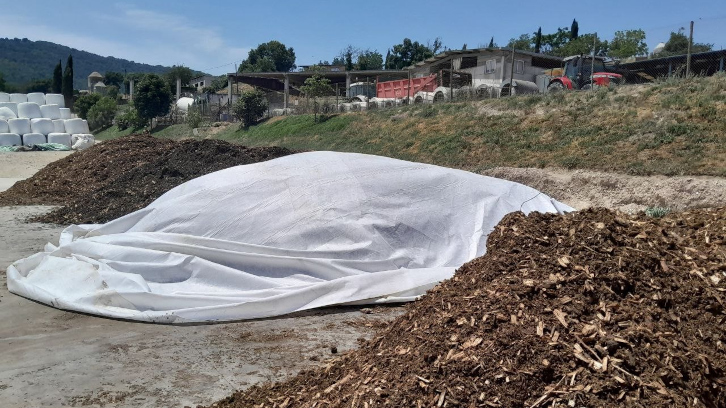
The article reviews the main current biotechnological technologies. Composting and anaerobic digestion are already widely implemented and enable the production of compost and biogas, respectively. However, it highlights the need to go further and incorporate emerging processes such as solid-state fermentation, which can generate bioproducts with higher added value. It also analyses technological combinations, for example, anaerobic digestion followed by thermal processes such as pyrolysis, which produce biochar, a material with multiple environmental and energy applications.
One of the main challenges is to ensure that these systems are truly sustainable from an environmental and economic point of view. To this end, Chemical Engineering provides essential tools such as material and energy balances, which enable facilities to be reliably dimensioned, as well as life cycle analyses and technical-economic studies, which are fundamental for decision-making by administrations and companies.
The following table groups together the main elements that the discipline can apply to contribute to the sustainability of these technological systems:
| Chemical Engineering item | Application |
|---|---|
| Mass and energy balances | Size of operations and bioreactors |
| Mass and energy balances | Life Cycle Assessment |
| Kinetics | Bioreactors design |
| Chemical reactors | Bioreactors design |
| Transport phenomena | Scale-up |
| Modelling and simulation | Test the performance of differrent configurations of the biorefinery |
| Heat transfer | Optimization of energy balance |
| Cost analysis | Techno-economic analysis |
The article also highlights future challenges: managing large quantities of digestate, difficulties in scaling up emerging technologies, the need for better models and simulations, and the growing role of artificial intelligence in the design and optimisation of biorefineries. Finally, it concludes that the combination of circular economy and chemical engineering can be decisive in transforming organic waste into a key pillar of a more sustainable economy, although more research and, especially, real-scale or pilot-scale experiences are still required.
Department of Chemical, Biological and Environmental Engineering
Universitat Autònoma de Barcelona
References
Sánchez, A. (2025). The role of chemical engineering in the organic waste-based circular bioeconomy: what has been done and what still needs to be done. A perspective. Front. Chem. Eng. 7:1730182. https://doi.org/10.3389/fceng.2025.1730182