

Stardust factories: How iron-rich cosmic grains may brew water in space
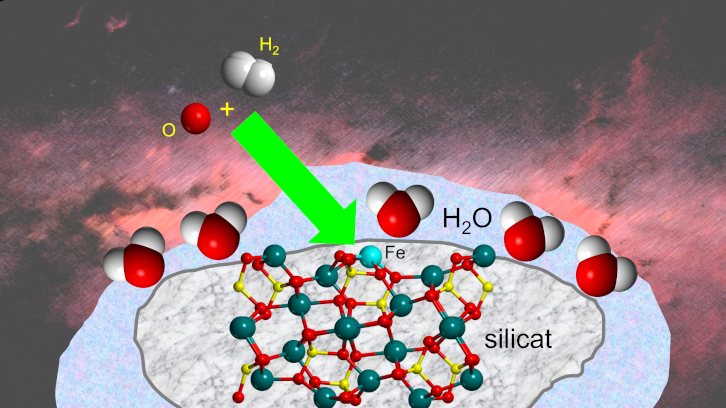
The Department of Chemistry has conducted a study to deepen our comprehension about the water in space. As most of space’s water exists as ice frozen, scientists believe surface chemistry on the grains is key. The innovation of the study has been to consider the water-formation molecules by the reaction of a single oxygen atom with a hydrogen molecule, since it has been found that quantum tunneling could make this feasible with the presence of iron in silicates.
Water is essential for life as we know it, and its surprising abundance in the frozen depths of space has long intrigued scientists. While interstellar clouds are extremely cold and sparse, they are rich in solid dust grains (tiny particles that act as cosmic chemistry labs). A new study developed by our QUANTUMGRAIN group using advanced computer simulations reveals how these grains, particularly those containing iron, might be crucial “factories” for producing water in the universe.
Most of space’s water exists as ice frozen onto the surfaces of silicate dust grains, like a frost coating on a windowpane. But how does this water form? In the harsh conditions of space, where temperatures can plunge near 10 Kelvin (-263°C) and molecules are few and far between, reactions that seem simple on Earth become major challenges. Gas-phase reactions alone can’t explain all the water we observe. Instead, scientists believe surface chemistry on the grains is key.
The prevailing mechanism for interstellar water formation is the addition of hydrogen atoms (H, the most abundant element in the universe) to atomic O; however, only taking this reaction into account does not explain its abundance, and hence other mechanisms must be considered. Our research focused on a specific, and previously unexplored, water-formation recipe: a single oxygen atom (O) reacting with a hydrogen molecule (H₂) directly on a dust grain surface. The study zoomed in on olivine, a common family of silicate minerals in space that often contains iron. Using quantum chemical simulations, we modeled this reaction on Fe2+, containing silicate surfaces.
The presence of iron is a game-changer. The simulations show that Fe²⁺ ions can capture and hold H₂ molecules, a first step toward activating them for reaction by stretching and weakening the H-H bond.
The most efficient reaction pathway involves the oxygen atom landing on the grain first. This step releases a burst of energy that can help power the next crucial step: splitting the H₂ molecule apart. One hydrogen atom attaches to the iron, while the other bonds to the silicate framework. These hydrogen atoms then shuffle across the surface until they meet the waiting oxygen, combining to form a molecule of water (H₂O).
While the energy barriers for these steps are high, the frigid temperatures of interstellar space offer a secret weapon: quantum tunneling. This quantum mechanical effect allows lightweight particles like hydrogen to "tunnel” through energy barriers rather than climbing over them. The study’s kinetic calculations confirm that, thanks to tunneling, this water-formation mechanism becomes viable over the million-year lifetimes of interstellar clouds. Furthermore, the study found that while iron helps store and activate H₂, the actual H₂-splitting step can have a lower barrier on pure magnesium silicates. This suggests iron-rich silicates might act more as reservoirs for hydrogen, while other sites facilitate its chemistry.
These findings not only deepen our understanding of where the universe’s water comes from but also pave the way for future laboratory experiments to test this promising cosmic recipe.
References
Marc Serra-Peralta, Christian Dominguez-Dalmases, Albert Rimola (2022). Water formation on interstellar silicates: the role of Fe²+/H2 interactions in the O + H2 → H2O reaction. Physical Chemistry Chemical Physics 24, 28381. https://doi.org/10.1039/D2CP04051D
You can access all publications on the ERC-QUANTUMGRAIN project website: https://www.quantumgrain.eu/publications/