Rubber balloons and volcanic lightning: an electrifying discovery in static electricity
What is there in common between planet-forming protoplanetary disks, volcanic lightning, and… rubbing a party balloon on your hair? All these systems produce static electricity through an unknown mechanism. In a recent paper in Nature, the UAB’s Department of Physics and ISTA used acoustic levitation to answer one of the big questions in the field: why do objects made of the same material exchange charge?
Rubbing a balloon on your hair produces static electricity. This is the triboelectric effect, shown in science classrooms all over the world. But here’s the rub: very little is actually known about the underlying mechanism. Experts even disagree on whether electrons, ions, or larger chunks of material are transferred. Given two objects, we cannot say for sure which one will charge positively or negatively: the only way to know is to measure it.
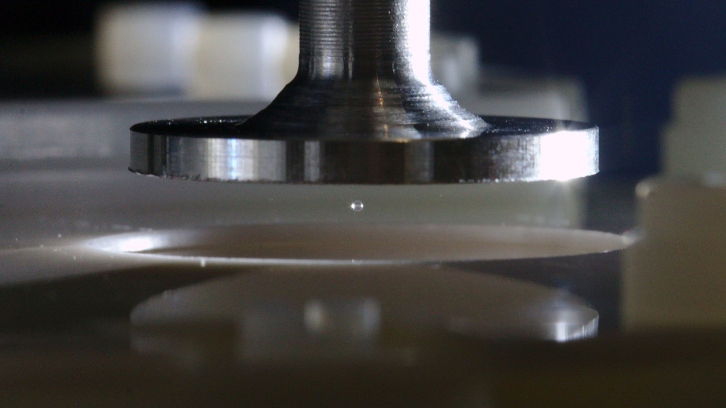
More puzzling still, same-material objects also exchange charge, and lots of it! This is especially true of powders and grains, where repeated collisions can build up to a big spark. This causes lightning during volcanic eruptions, triggers industrial explosions, and might even play a key role in the formation of rocky planets. But measuring this effect is tricky. Any contact can cause electrification. The solution? Make the experiment contact-free with acoustic levitation. Using ultrasound, millimeter-sized grains can be trapped and their charge measured with extreme precision. To cause contact, the trap is turned off, causing the grain to fall and bounce on a target plate. With the right timing, it is then caught again by the ultrasound. To obtain statistics, this little trick must be repeated thousands of times!
With our method, we studied oxides, the same materials that rocky planets, asteroids, or volcanic ash are made of. The key was to look at their surfaces. Even in ultra-clean environments, tiny amounts of carbon-based molecules deposit on any surface. Removing this carbon from a sample, using heat or plasma, causes it to always charge negatively! Over a few hours, this effect relaxes, as carbon progressively comes back. Over time, identical samples will grow slightly different carbon layers, causing them to charge more positively or negatively. While there is still much to learn, identifying surface carbon as the key parameter is a major step forward that will surely help lead the charge in future research.
Department of Physics
Universitat Autònoma de Barcelona
References
Grosjean, G., Ostermann, M., Sauer, M. et al. (2026) Adventitious carbon breaks symmetry in oxide contact electrification. Nature 651, 626–631. https://doi.org/10.1038/s41586-025-10088-w