
Rediscovering female preaching in medieval and premodern Europe
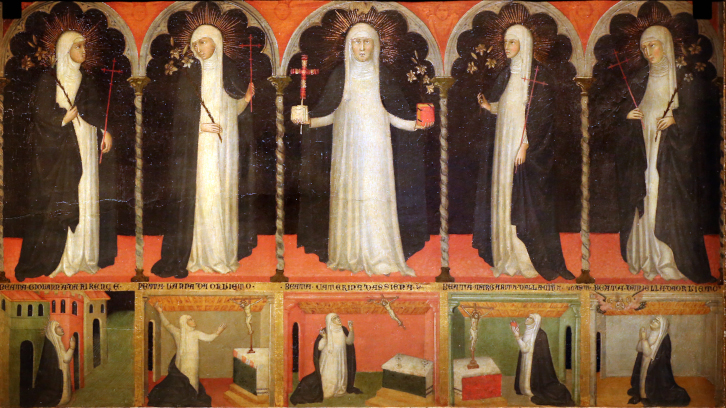
A project involving the Faculty of Arts and Humanities examines the role of women preachers in medieval Europe. A bibliography has been compiled that demonstrates that these women had their own communication strategies, distinct from those of their male counterparts, who are often the only ones taken into consideration in traditional historiography. This study aims to be a first step for researchers who wish to delve deeper into female preaching and build an international framework for their field of study.
This bibliography seeks to open up new avenues of study in a germinal field: female preaching in the Middle Ages and the early modern period, that is, the public, oratorical, and performative use of the word by certain women. Despite the prejudices inherited from traditional historiography, it is clear that in Europe there were not only male preachers but also female preachers, whose genealogy can be traced back at least to the twelfth century. They did not share the modes of their male counterparts—symbolized by the use of the pulpit as the privileged place for addressing crowds—but instead developed their own communicative strategies. As one of the scholars who founded this field, Gabriella Zarri, pointed out, women also preached, but their options were different. She summarized them as prophecy (speech inspired by the divine) and sacra conversazione (an educational form of oratory used by some abbesses within their communities). Thus, for example, the German women Hildegard von Bingen (1098–1179), Elisabeth von Schönau (1129–1164/5), and Mechthild von Hackeborn (1241–1298); the Venetian Chiara Bugni (1471–1514); the Castilian Juana de la Cruz (1481–1534); and the Catalan Isabel de Josa (1490–1564) all belong to a tradition that used the living word to communicate with diverse audiences and to influence them in multiple ways—something that did not exclude, but rather fostered, their political impact. The public preaching of these religious women drew together varied audiences, including disciples, learned people, peasants, aristocrats, and religious authorities. Their speeches survive in collections of sermons, books of revelations, hagiographies, and other documents preserved in archives and libraries, many of which remain unedited.
This bibliography, compiled by four scholars from four different universities—Carolyn Muessig (University of Calgary), Patricia Stoop (Universiteit Antwerpen, Ruusbroec Institute), Edward Sutcliffe (University of Oxford, Lady Margaret Hall), and the author of these lines, Pablo Acosta-García (Universitat Autònoma de Barcelona)—has its origins in the workshop Female Preachers in Premodern Europe, organized by Carolyn Muessig at the Calgary Institute for the Humanities, which brought us together there from 1 to 3 May 2023. It has a strong interdisciplinary character, aims to build an international framework for its subject of study, and is intended as a first step for researchers who wish to delve more deeply into the topic.
Departament of Arts and Musicology
Faculty of Arts and Humanities
Universitat Autònoma de Barcelona
References
Muessig, C., Acosta-García, P., Stoop, P., & Sutcliffe, E. (2025). Select Bibliography: Female Preaching in Premodern Europe. Medieval Sermon Studies, 69/1, 1-12. https://doi.org/10.1080/13660691.2025.2586406.