
Hydrogen from wastewater: from the laboratory to the treatment plant
For over 15 years, the GENOCOV research group in the Department of Chemical, Biological, and Environmental Engineering has been studying microbial electrolysis cells to harness the chemical energy contained in wastewater. The most recent results show that this technology not only produces promising and efficient hydrogen in the laboratory, but also in an accelerated manner in the long term.
Conventional wastewater treatment systems consume large amounts of energy, yet wastewater itself contains substantial chemical energy that could be recovered. In recent decades, microbial electrochemical technologies (METs) have emerged as a promising alternative, reframing wastewater not as a waste stream but as a valuable resource for energy and material recovery. Among these technologies, microbial electrolysis cells (MECs) stand out for their dual function: treating wastewater while generating valuable products such as hydrogen.
MECs consist of two electrodes separated by membranes and connected to an external power supply. On the anode, electroactive microorganisms oxidize organic matter present in the wastewater, releasing electrons that are then transferred to the cathode, where hydrogen is produced. Although laboratory-scale MECs have shown excellent performance, scaling up the technology while maintaining efficiency remains a major challenge.
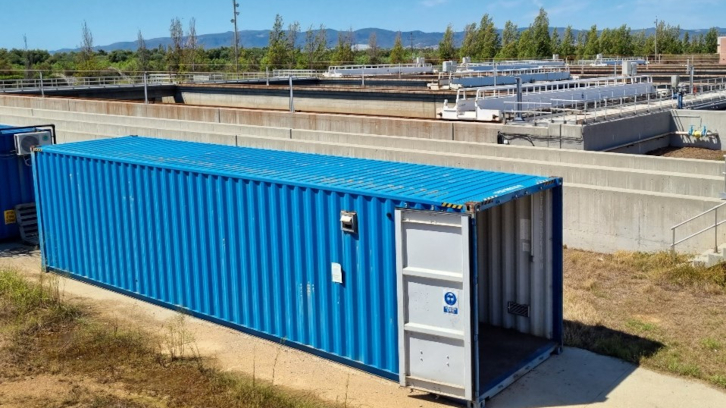
In the GENOCOV research group in the Chemical, Biological, and Environmental Engineering Department (DEQBA) at UAB we have been investigating MECs for over 15 years. While small-scale MECs have demonstrated high hydrogen yields and efficient COD removal, their performance typically drops at larger scales. Key engineering issues, such as mass transfer limitations, electrode spacing, and material costs, have constrained the progress of MECs toward real-world application. To address these gaps, reactor design and operational strategies must be adapted for practical, full-scale conditions. Thanks to the Life Nimbus project, we have been able to collaborate with Cetaqua, Aigües de Barcelona and TMB to validate this technology on a pilot scale at the wastewater treatment plant (WWTP) in El Prat de Llobregat.
A) Monitoring system and power sources; B) MEC pilot plant; and C) Different cassette-type modules placed inside the reactor.
In this study, we present the design, construction, and operation of a 1 m3 double-chamber MEC, the largest pilot plant installed to date in an urban WWTP. The system, based on a modular cassette configuration, was operated for more than 250 days using both synthetic and real urban wastewater. The pilot plant achieved stable electroactive biofilm development directly from untreated primary effluent, without the need for external carbon sources or chemical amendments. Under optimal conditions, the MEC reached continuous hydrogen production rates of 8.59 liters of hydrogen per square meter per day with synthetic wastewater and 7.29 liters of hydrogen per square meter per day when treating real wastewater. COD removal reached up to 51 %, demonstrating simultaneous wastewater treatment and energy recovery in a large-scale system not demonstrated before. Importantly, these results are comparable to those achieved in smaller pilot reactors, confirming that MEC performance can be preserved during scale-up. Furthermore, a techno-economic analysis revealed that MECs can reach energy-neutral or energy-positive operation in different scenarios.
By demonstrating stable long-term operation, high hydrogen purity, and performance comparable to smaller systems, the study shows that MEC scale-up is technically feasible. Future efforts to make this technology applicable at full scale should focus on increasing the productivity, reducing capital costs, minimizing hydrogen leakages, and targeting high-strength industrial wastewaters where MECs can offer better benefits. With these improvements, MECs could become a competitive technology for renewable hydrogen production, resource recovery, and advancement of the circular economy.
Research group on biological treatment of liquid and gaseous effluents, GENOCOV
Chemical, Biological and Environmental Engineering Department
School of Engineering
Autonomous University of Barcelona
References
(1) Guerrero-Sodric, Oscar, Juan Antonio Baeza, and Albert Guisasola. "Exploring key operational factors for improving hydrogen production in a pilot-scale microbial electrolysis cell treating urban wastewater." Chemical Engineering Journal 469 (2023): 144001. (https://doi.org/10.1016/j.cej.2023.144001).
(2) Guerrero-Sodric, Oscar, Juan Antonio Baeza, and Albert Guisasola. "Enhancing bioelectrochemical hydrogen production from industrial wastewater using Ni-foam cathodes in a microbial electrolysis cell pilot plant." Water Research 256 (2024): 121616. (https://doi.org/10.1016/j.watres.2024.121616).
(3) Guerrero-Sodric, Oscar, Juan Antonio Baeza, and Albert Guisasola. "Scaling up microbial electrolysis cells (MECs) for hydrogen production: Design, construction and operation of a 1 m3 pilot plant in an urban wastewater treatment plant." Chemical Engineering Journal (2025): 168035. (https://doi.org/10.1016/j.cej.2025.168035).