
How Organic Molecules Stick to Cosmic Ice? New Insights into Interstellar Chemistry
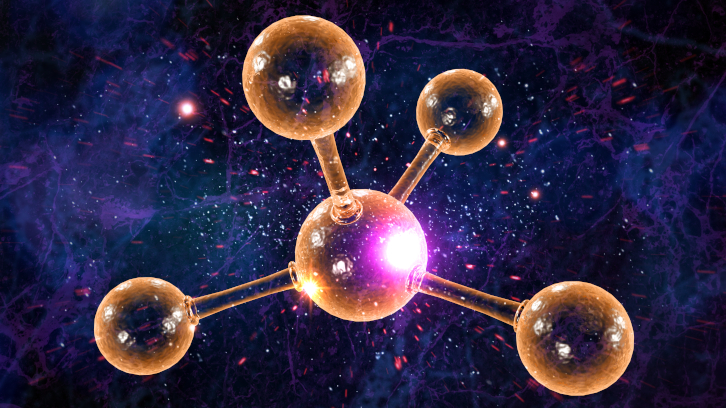
A new study, conducted in collaboration with the QuantumGrain research group from the Department of Chemistry at the UAB, reveals how organic molecules bind to the ice on the dust grains in space. The research shows that adherence is higher than previously thought, which affects how these molecules react, detach, and end up forming part of the future planets.
Complex organic molecules (iCOMs), i.e., molecules containing six or more atoms including carbon, are key ingredients in the chemistry of the interstellar medium. They include alcohols, aldehydes, nitriles, small acids, and other reactive species that participate in pathways leading to prebiotic molecules. Observations have shown that iCOMs are widespread in cold molecular clouds, protostars, and planet-forming disks, despite the extreme conditions that should otherwise limit their mobility and survival. A central question in astrochemistry is therefore how these molecules form, remain stable, and transition between the solid and gas phases in such environments.
A crucial factor governing their behaviour is the binding energy: the strength with which a molecule adheres to the icy mantles that coat interstellar dust grains. These ice surfaces, composed mainly of amorphous or crystalline water, provide both a chemical substrate and a physical reservoir for iCOMs. Binding energies determine whether a molecule remains frozen onto the dust grain or desorbs into the gas, thereby influencing observable abundances and the progression of chemical networks. Many commonly used values are based on simplified water clusters, which often underestimate the true strength of molecule–ice interactions.
The present study addresses this limitation by evaluating adsorption energies for 19 representative iCOMs using realistic periodic models of crystalline and amorphous water ice. These models capture the extended hydrogen-bond networks characteristic of astrophysical ice mantles, enabling a more accurate assessment of how strongly each molecule binds.
Binding energies of several iCOMs have been evaluated on crystalline and amorphous water ice mantles present on interstellar dust grains. Comparisons with earlier literature show that the values are much higher and hence significantly impact the astrochemical modelling and molecular evolution of the interstellar medium.
The results reveal consistently higher binding energies across most iCOMs compared to earlier cluster-based estimates. This suggests that iCOMs are more securely retained on icy dust grains than previously assumed. In cold, dense clouds, this stronger adhesion may prolong the residence time of molecules on the grain surface, providing more opportunity for surface reactions to occur. In warmer or dynamically evolving environments such as protoplanetary disks, higher binding energies determine which species are available for incorporation into forming planets.
A notable outcome is the wide distribution of binding energies observed on amorphous ice. Its irregular surface topology creates diverse adsorption sites with varying strengths, meaning that molecular behaviour cannot be captured by a single characteristic value. This variability has important implications for chemical models that simulate diffusion, reactions, and desorption processes on grain surfaces.
Overall, the study highlights the need to update astrochemical databases with more realistic binding energy values and, where possible, distributions rather than single numbers. Incorporating these results into chemical networks will improve predictions of iCOM evolution and help interpret increasingly detailed observations from modern telescopes, refining our understanding of how molecular complexity arises in the interstellar medium.
References
Harjasnoor Kakkar, Berta Martínez-Bachs, Cecilia Ceccarelli, Piero Ugliengo, and Albert Rimola, Binding Energies of Interstellar Complex Organic Molecules on Water Ice Surfaces: A Quantum Chemical Investigation, Astrophysical Journal, 2025, 993, 184. https://doi.org/10.3847/1538-4357/ae064a