
How do plants adapt when colonizing new territories? Genomic evidence from Leontodon longirostris
A recent study sheds light on the genetic basis of adaptations that plants undergo when they colonize new territories and must face environmental conditions that differ from those in their area of origin. The research was focused on a plant native to the western Mediterranean that has extended to the northern Iberian Peninsula: Leontodon longirostris.
When a species expands into new territories, it often faces environmental conditions that differ from those in its area of origin. Understanding how organisms adapt during such processes is essential for predicting their responses to global change. In this study, we analyze the genomic mechanisms that have enabled Leontodon longirostris to successfully colonize the northern Iberian Peninsula over the last several thousand years.
This short-lived species, native to the western Mediterranean, grows in abandoned fields, annual grasslands and roadsides. Around 40,000 years ago, it expanded from southern to northern Iberia along a marked climatic gradient, moving from warm and dry conditions in the south to colder and wetter environments in the north. This expansion was accompanied by adaptive changes in key life-history traits, such as the timing of germination and flowering, allowing longer life cycles under the cooler and more humid conditions of its new range.
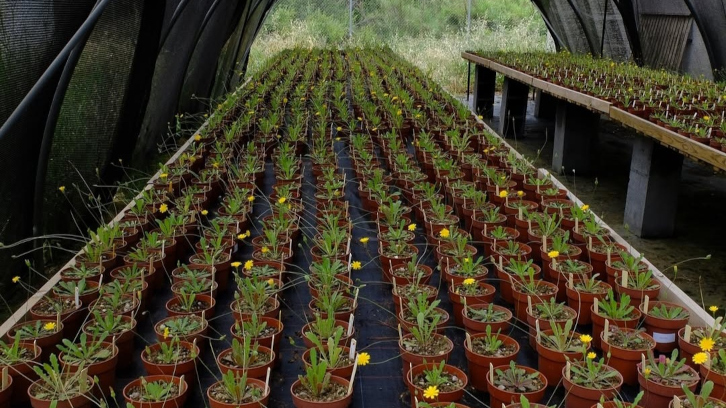
In this study, we investigated the genetic basis of these adaptations. Specifically, we tested whether adaptation to new environments was primarily driven by pre-existing genetic variation in the source populations or by new mutations arising during the expansion. To address this question, we combined data from more than 160,000 genomic variants with phenotypic information from common garden experiments and climate data.
Our results indicate that adaptation during northward expansion was primarily driven by selection acting on pre-existing genetic variation. This variation acts as a reservoir that enables rapid responses when environmental conditions change, even under the reduced genetic diversity commonly observed at expansion fronts. In addition, we identified a small set of candidate genes potentially involved in the phenotypic changes observed during the expansion, most of which are involved in signaling pathways integrating environmental cues such as light, temperature, water availability, and presence of pathogens. These signaling networks act as a flexible regulatory toolkit to dynamically adjust to environmental conditions, ensuring optimal growth and reproduction.
In short-lived plants, in particular, sensory genes regulating phenological transitions with significant effects on survival and fitness, such as germination and flowering, can be crucial for colonizing new habitats. Subtle modifications in these networks may translate into substantial shifts in life-history strategy, moving from shorter to longer life cycles, without the need for major genetic changes.
Overall, this work highlights the importance of conserving natural genetic diversity to maintain the evolutionary potential of species and underscores the central role of regulatory and signaling mechanisms in the rapid evolution of key traits under changing environmental conditions.
References
Mayol, M., de Pedro, M., Riba, M., González-Martínez, S. C. (2026). Genomic signatures of adaptation along an expansion route in the colonizing plant Leontodon longirostris (Asteraceae). Journal of Evolutionary Biology 39, 249–261. https://doi.org/10.1093/jeb/voaf133