
Cosmic HCN: how poison may have helped build life's blueprint
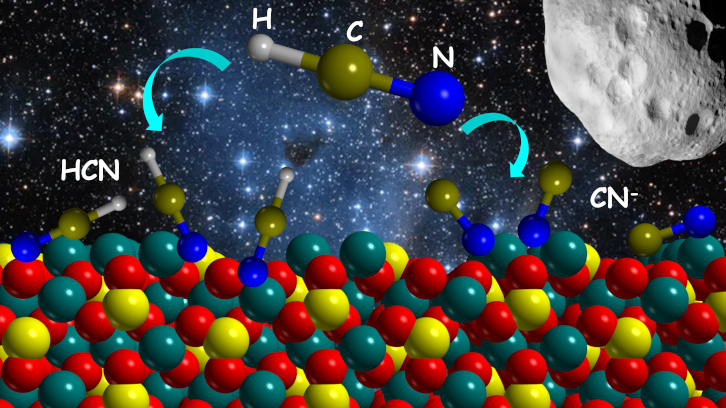
The QUANTUMGRAIN research group at the Department of Chemistry has carried out sophisticated atomistic simulations to investigate what happens when hydrogen cyanide (HCN), a possible precursor to life, interacts with interstellar silicate surfaces. The study shows that HCN is not only activated but also participates in a rich and varied chemistry of interest to astrobiology. It also reveals the role of these surfaces in promoting the activation of HCN and its participation in various chemical reactions.
In the vast, cold expanse of space, among the swirling dust and gas of star-forming regions, one of the most intriguing and toxic molecules to us, hydrogen cyanide (HCN), is surprisingly common. It’s been spotted everywhere from the frigid cores of dense clouds to the warm disks where planets are born, and even on comets and meteorites. But HCN is more than just cosmic poison; it’s a potential precursor to life’s building blocks, like adenine, a key component of DNA. The mystery lies in the “where” and “how.”
In the near-perfect vacuum of space, gas-phase HCN molecules rarely collide and react. Thus, for complex chemistry to begin, a solid surface is needed: a stage for molecules to meet and interact. Cosmic silicates, the rocky dust that makes up a significant fraction of interstellar grains and rocky planets, are prime candidates. Among them, the magnesium-rich silicate forsterite (Mg₂SiO₄) is a key model.
Our QUANTUMGRAIN research group performed sophisticated quantum mechanical atomistic simulations to investigate what happens when HCN encounters different crystalline surfaces of forsterite. We found that HCN doesn't just stick lightly to the dust; it engages in a rich and varied chemistry.
The simulations revealed two main modes of interaction: molecular adsorption, where HCN stays intact, and dissociative adsorption, where it readily donates a proton (H⁺) to an oxygen atom on the silicate surface, leaving behind a reactive cyanide ion (CN⁻). This deprotonation step is crucial, as CN⁻ is the chemically active species thought to kickstart the polymerization that ultimately can lead to adenine.
Notably, the study found that dissociative adsorption is often dominant even at the extremely low temperatures (around 10 K) of dark interstellar clouds. This is because the most irregular silicate surfaces expose oxygen sites eager to accept a proton. As environments warm up—like in protoplanetary disks or on asteroids—this tendency becomes even more pronounced, flooding the grain surface with reactive CN⁻.
Our simulations also provide a spectroscopic fingerprint for future astronomical observations (through which cosmic molecules are detected), showing that the stretching frequencies of the HCN’s C–H and C≡N bonds shift significantly upon adsorption, with the shifts correlating directly with the bond’s weakening or strengthening. These predicted spectral signatures could one day not only help astronomers identify not just HCN in space but also discern whether it is passively sitting on dust or actively being processed by it.
In essence, this work paints a vivid picture: interstellar and planetary silicates are not passive bystanders. They are active catalytic surfaces that can efficiently activate simple but astrobiologically vital molecules like HCN.
References
Niccolò Bancone, Stefano Pantaleone, Piero Ugliengo, Albert Rimola, Marta Corno (2023). Adsorption of HCN on cosmic silicates: a periodic quantum mechanical study. Physical Chemistry Chemical Physics, 25, 26797-26812. https://doi.org/10.1039/D3CP01459B
You can access all publications on the ERC-QUANTUMGRAIN project website: https://www.quantumgrain.eu/publications/