
Circular Economy: Reality or Wish?
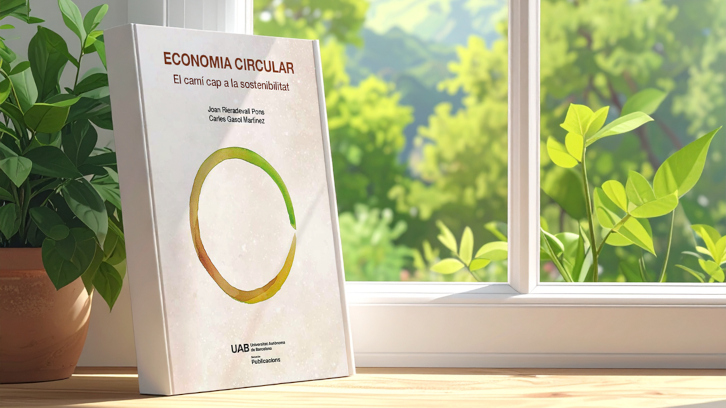
The circular economy is presented as an alternative to the current model of production and consumption, often based on producing, using, and discarding. In the book Economia circular. El camí cap a la sostenibilitat, researchers affiliated with the UAB analyze the factors that can accelerate—or slow down—the transition toward more sustainable models.
The current economic model, often based on producing, consuming, and discarding, increasingly shows its limits. The constant extraction of resources and the growth of global consumption generate rising environmental impacts. In fact, today only 7.2% of the world’s products and services can truly be considered circular, while forecasts indicate that global consumption will continue to increase in the coming decades.
In this context, the circular economy has become one of the key strategies for moving toward more sustainable production and consumption models. Its objective is to keep resources within the system for as long as possible, reduce waste generation, and make better use of the value of materials.
With this idea in mind, we wrote the book Economia circular. El camí cap a la sostenibilitat, which aims to bring readers closer to the current situation and future potential of the circular economy, considering political, social, and economic conditions. The work brings together more than two decades of research, projects, and collaborations with companies, public administrations, and other researchers dedicated to improving the environmental impact of products and production processes. The book was initially published in Spanish and is now also available in Catalan, both in print and in open-access electronic format.
Figure from the book showing its main sections. Source: own elaboration.
The structure of the book moves away from a purely descriptive presentation of the circular economy and instead offers a committed perspective, incorporating both optimistic and critical views on its implementation at global, European, and local scales. At the beginning, one of the questions we pose is clear: will the circular economy become a reality in the coming years, or will it remain mostly a wish? To answer this, we analyze various factors that may facilitate or hinder this transition, from technological advances to public policies, business decisions, and consumer habits.
On the one hand, there are reasons for optimism. Environmental regulations are increasing, interest in sustainable products and services is growing, and many organizations are exploring new ways of producing with lower environmental impact. On the other hand, there are also significant obstacles, such as the perception that sustainable products are more expensive and the difficulties many companies face in transforming their business models.
Throughout the book we present policies, tools, and strategies that can help advance toward a more circular economy, as well as real examples of ecodesign and innovation applied to products, services, and territories. These cases show that the transition is already underway, although there is still a long way to go.
The question, therefore, is no longer whether we should move toward a circular economy but how we can accelerate this transition to build a more environmentally sustainable future.
Carles Gasol Martínez
Department of Chemical, Biological and Environmental Engineering. Chemical Engineering Area
Co-founding partner of Inèdit Innovació, a knowledge transfer company in circular economy linked to the UAB Research Park.
Carles.Gasol@uab.cat
Joan Rieradevall Pons
Department of Chemical, Biological and Environmental Engineering. Chemical Engineering Area
Scientific advisor to the Sostenipra group at ICTA-UAB and co-founding partner of Inèdit Innovació and Tectum Garden.
Joan.Rieradevall@uab.cat