
Biomethanation: producing high-energy gas thanks to microorganisms
A study by the GENOCOV group of the Department of Chemical, Biological and Environmental Engineering has developed a method to accurately calculate the speed at which certain microorganisms consume the hydrogen needed to produce methane gas from CO2. This research is useful for better understanding these processes and thus designing more efficient reactors to transform, for example, CO2 from biogas into clean energy.
At a time when we are seeking more sustainable energy alternatives, biogas has become a key component of the circular economy. In certain waste management facilities, including wastewater treatment plants, biogas often contains a high proportion of carbon dioxide, which reduces its energy value. For this reason, one of the most promising lines of research is biomethanation, a process that involves converting this CO2 into methane using microorganisms capable of simultaneously utilizing hydrogen to carry out this transformation, allowing the resulting (bio)methane to be used later as fuel or distributed through the existing natural gas grid.
The problem is that hydrogen is a gas that is very poorly soluble in water, making it difficult to know precisely how fast microorganisms consume it. Until now, most measurement methods had limitations because of this.
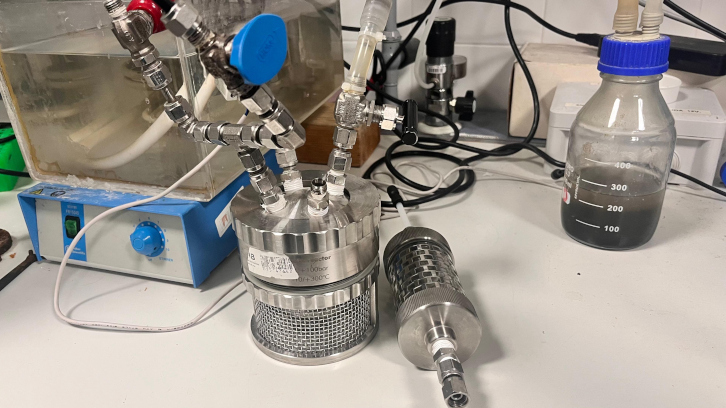
In this work, we have developed a new way of measuring this activity, which overcomes the obstacles of traditional methodology. The method consists of first dissolving hydrogen under pressure in the liquid and then completely sealing the reactor so that there is no longer a gas phase. From this point on, we simply monitor how the dissolved hydrogen decreases over time. This allows us to observe the activity of microorganisms directly, without interference.
Thanks to this system, we have been able to study how temperature affects the activity of a culture of methane-producing microorganisms. We have discovered that as the temperature increases, the activity also grows very clearly, reaching a maximum at around 65°C. However, at 70°C, the activity disappears completely, as these temperatures damage the biological culture. We also verified that traditional methods underestimated the actual activity at high temperatures, simply because the hydrogen did not reach the microorganisms quickly enough.
This new way of measuring the microbial activity of hydrogen-consuming cultures is more accurate and much faster, allowing us to better understand these processes and design more efficient reactors for converting CO2 into clean energy.
Department of Chemical, Biological and Environmental Engineering
Universitat Autònoma de Barcelona
References
Manuel Fachal-Suárez, Àlex Gaona, Pablo Benavides, Javier Lafuente, Marc A. Deshusses, Daniel Gonzalez, David Gabriel (2025). Assessing the temperature effect on the kinetics of a hydrogenotrophic methanogenic culture using a novel headspace-free methodology, Chemical Engineering Journal Advances, 24 https://doi.org/10.1016/j.ceja.2025.100951