

Application of bacteriophages in eggs, an early preventive barrier against "Salmonella"
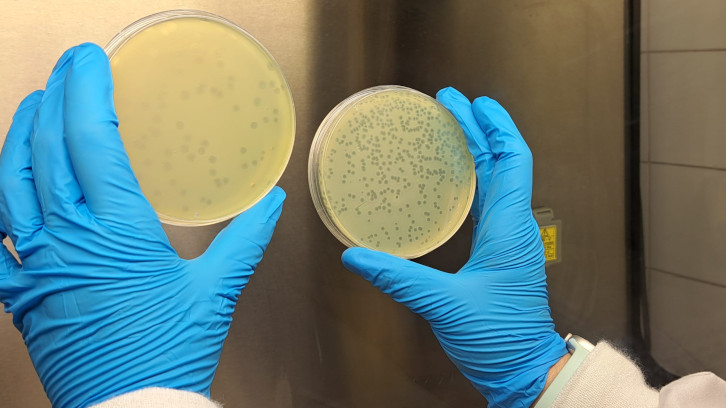
Bacteriophages are emerging as an innovative and sustainable tool for the biocontrol of pathogens in animal production. Researchers from the UAB have collaborated in a groundbreaking study, published in Food Control, proposing a pioneering technique: the in ovo administration of bacteriophages as an early preventive barrier against Salmonella enterica serovar Typhimurium, thereby limiting its transmission in poultry production and improving food safety in broiler chickens.
Researchers from the Molecular Microbiology Group in the Department of Genetics and Microbiology at the UAB have taken part in a scientific study led by the Poultry Quality and Animal Nutrition Centre of the Valencian Community (CECAV), in collaboration with CEU Cardenal Herrera University and the Food & Health Lab of the University of Valencia. he study,explores an innovative alternative to reduce the spread of Salmonella in poultry production: the use of bacteriophages applied directly to eggs (in ovo) before hatching. This approach will help to strengthen biosecurity from the very beginning of poultry production and opens new pathways for limiting the dissemination of pathogens throughout the production chain.
Hatcheries represent a critical point in the broiler production chain, as large numbers of animals are concentrated in confined spaces, and they also act as a source of dispersion due to the routine transfer of chicks from these facilities to production farms. Therefore, controlling the presence of pathogens in hatcheries can drastically reduce their spread and proliferation across wide geographical areas. This study focused on the control of Salmonella, one of the main causative agents of foodborne outbreaks in humans linked to the consumption of food contaminated with this bacterium, and a major threat to both food safety and public health.
The study employes bacteriophages (or phages), naturally occurring viruses that infect and destroy specific bacteria, and assessed the safety and effectiveness of their administration in eggs as a preventive measure against Salmonella. The findings were encouraging, showing that inoculation of phages into the amniotic fluid is the safest and most effective route of treatment. Moreover, chicks hatched from treated eggs exhibited significantly lower colonisation than untreated ones when directly infected with Salmonella, confirming the treatment’s effectiveness. Notably, injection of phages into the eggs completely prevented the transmission of Salmonella in birds indirectly exposed to this pathogen.
This in ovo administration strategy functions as a preventive measure capable of halting the spread of the pathogen from the very start of the production chain. Furthermore, it provides a promising tool against the growing challenge of bacterial resistance to antimicrobials, since it employs a highly specific, natural mechanism against pathogenic bacteria.
This breakthrough paves the way for new applications of phage therapy in the food industry and offers a sustainable, antibiotic-free alternative, applied from the hatchery to reinforce biosecurity in poultry production from the outset, protecting animals, producers and consumers alike.
Departament of Genetics and Microbiology
Universitat Autònoma de Barcelona
References
Jan Torres-Boncompte, Josep Garcia-Llorens, Pilar Cortés, Anna Martínez-Sánchez, Montserrat Llagostera, Susana Campoy, José M. Soriano, Pablo Catalá-Gregori, Sandra Sevilla-Navarro. 2026. In ovo phage administration to mitigate Salmonella Typhimurium colonization in broiler chickens – A new firewall strategy for the poultry industry. Food Control, Volume 180, 111637. https://doi.org/10.1016/j.foodcont.2025.111637