Ant game of thrones: how insect societies solve reproductive conflict
A study from UAB reveals that behind the apparent harmony of ant colonies lie intense struggles for reproductive control. Queens and workers deploy opposing strategies to determine who reproduces, maintaining a balance between conflict and cooperation that is essential for colony survival.
At first glance, colonies of social insects such as ants, wasps, and bees may seem like true utopias, but this idyllic image is only superficial. Beneath this apparent order lie surprisingly complex dynamics, with tensions and power struggles that rival the plot of Game of Thrones. It is precisely in this scenario where our study has revealed unexpected mechanisms that ultimately determine who leaves a mark on the next generation.
These communities, ranging from just a few dozen to millions of individuals, are among the most fascinating natural systems for studying the evolution of social behaviour. In fact, the largest known society after humans is an ant supercolony stretching from Portugal to Italy. This colossal scale gives an idea of the potential of these biological organisations, where what appears to be absolute cooperation actually hides a much more fragile and intriguing balance than one might expect.
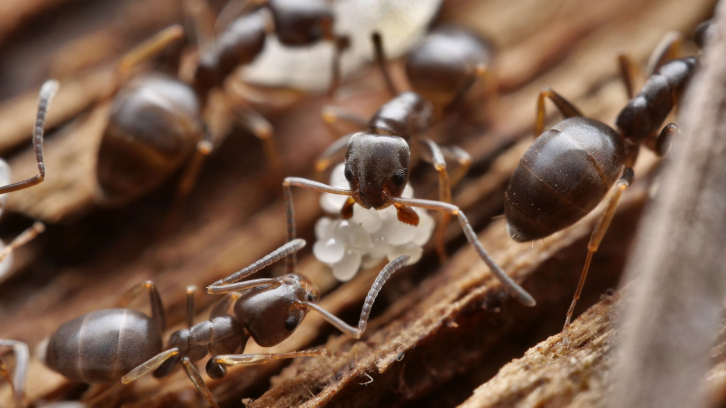
Our study focuses on the species Tapinoma darioi, a supercolonial ant with interconnected nests that can host millions of workers and hundreds of queens. In these societies, only queens reproduce, while workers depend indirectly on the reproductive success of the queens to which they are related. However, in such a large colony, it is very likely that many workers are caring for queens to which they have no genetic relationship.
This ant metropolis creates the perfect setting for the emergence of internal conflict, among which stands out the competition between reproductive individuals to determine who will have the right to produce the next generation of queens. But when their number is very high, not all can reproduce, and competition becomes inevitable.
Our results show a remarkable mechanism: queens can influence the future of their offspring by injecting juvenile hormone into eggs, thereby promoting the development of their daughters into queens. This strategy increases the likelihood of perpetuating their genetic lineage, but at the same time triggers an arms race within the colony over who produces more offspring.
However, a colony made exclusively of queens would be unviable, so the balance between reproductive individuals and workers is essential for the group’s survival. The workers in these societies do not simply sit back with their legs crossed waiting for their community to collapse: we have observed that, thanks to their ability to detect the fate of developing larvae, they can identify when there is an excess of future queens. When this happens, they intervene firmly: they eliminate the excess larvae through cannibalism before the colony invests too many resources into them. In fact, we have detected that an artificial increase in juvenile hormone in queens leads to a higher rate of cannibalism of larvae destined to become reproductive individuals by the workers.
These results reveal the ability of these ants to dynamically adjust their social structure, maintaining an optimal balance between castes and preventing colony collapse. Far from being harmonious societies, these colonies function thanks to a delicate balance between cooperation and conflict; a fundamental aspect of social organisation in nature.
Who knows whether reading our article might provide new sources of inspiration for George R. R. Martin to continue writing his iconic book series…
Department of Animal Biology, Plant Biology and Ecology
Universitat Autònoma de Barcelona
References
Saureu, D.A., González-Lleida, P. & Oliveira, R.C. Hormonal modulation of brood allocation underlying evolutionary conflicts in the supercolonial ant Tapinoma darioi. Behav Ecol Sociobiol 80, 43 (2026). https://doi.org/10.1007/s00265-026-03720-w.