Equitat.org report, by Elisabet Pladevall Ballester
Suggestions for improving English learning at school
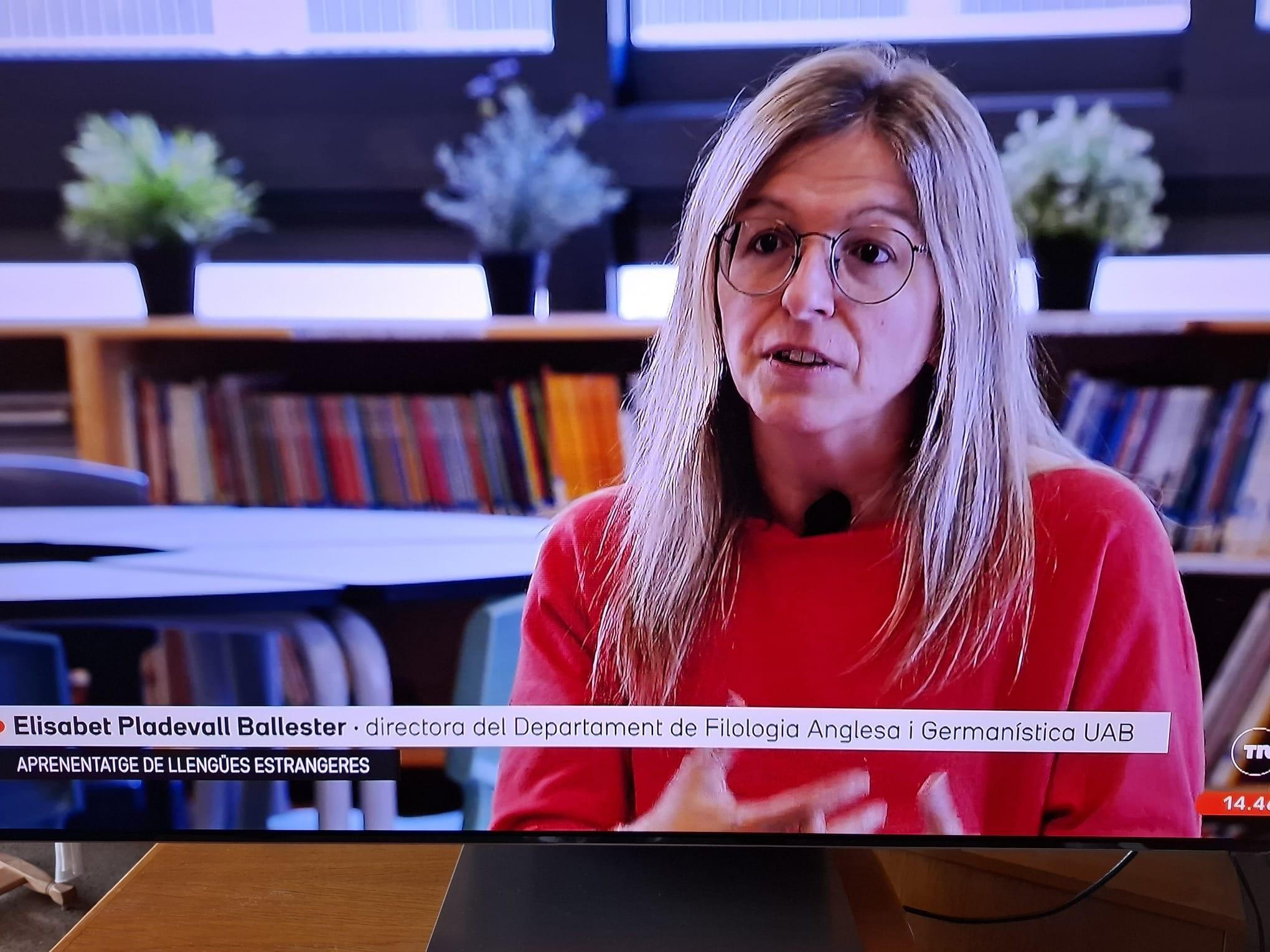
On April 29, the Equitat.org Foundation (formerly the Bofill Foundation) published a report on the current state of English learning in Catalonia, with proposals to improve it. The report was led by the professor and researcher from this department, Elisabet Pladevall Ballester.
Here are the links to the full report and the TV3 news article about its publication and main points:https://www.equitat.org/app/uploads/2026/04/Propostesmilloraprenentatgeangles.pdfhttps://www.3cat.cat/3catinfo/endarrerir-langles-perque-laprenguin-millor-la-decisio-duna-escola-basada-en-la-recerca/noticia/3406925/
The rather discouraging results in basic skills assessments and oral English production highlight the need to improve the learning of this foreign language in order to ensure the expected level by the end of compulsory secondary education (B1). What the report proposes is not to increase the number of years of instruction, but to improve the quality of this learning. Currently, Catalan students spend around ten years of their education learning English, a fact that is not reflected in their results at the end of secondary school.
Thus, taking into account the available resources and the context of exposure to English in Catalonia, Elisabet Pladevall Ballester presents a research-based proposal in which the first years of exposure to English serve to familiarize students with the language. Afterwards, a minimum of three hours per week of English would be devoted in the third or fourth year of primary education, and finally two additional hours would be introduced in the fifth or sixth year, with an emphasis on smaller groups. Of these five minimum hours, three would be allocated to traditional language instruction and the other two to more playful activities that promote oral skills and communication.
As Elisabet Pladevall points out, it is first necessary to consolidate students’ first and vehicular languages so that introducing English later becomes easier, with a stronger focus from around the age of 9, when students are at an optimal cognitive stage to learn a language explicitly in our learning context. In this way, the increase in hours of exposure to English is facilitated and the ideal conditions for more productive learning are created. Likewise, smaller groups encourage individualized attention and better management of diversity in the classroom.
However, the report also takes into account the social differences that exist today, acknowledging the difficulties and declining results in high-complexity schools. On the other hand, it also recognizes the financial effort many families make by investing in English as an extracurricular activity in mostly private institutions, which further increases the previously mentioned inequalities.
Finally, the report includes seven concrete proposals to improve English learning in Catalonia, including: updating the system for assessing and comparing skills at an international level, clearly defining the objectives for each educational stage, reorganizing the curricular hours of English during primary education, mandatory teacher training, support and mentoring for teachers and schools, increasing the number of language assistants, and creating a program that promotes the use of English outside the classroom, as well as subsidized extracurricular activities in English, especially for high-complexity schools.
The report takes a realistic yet firm approach to English learning in Catalonia and aims to support teachers in the process while reducing current inequalities in the education system.