Continuously rethinking and transforming concepts
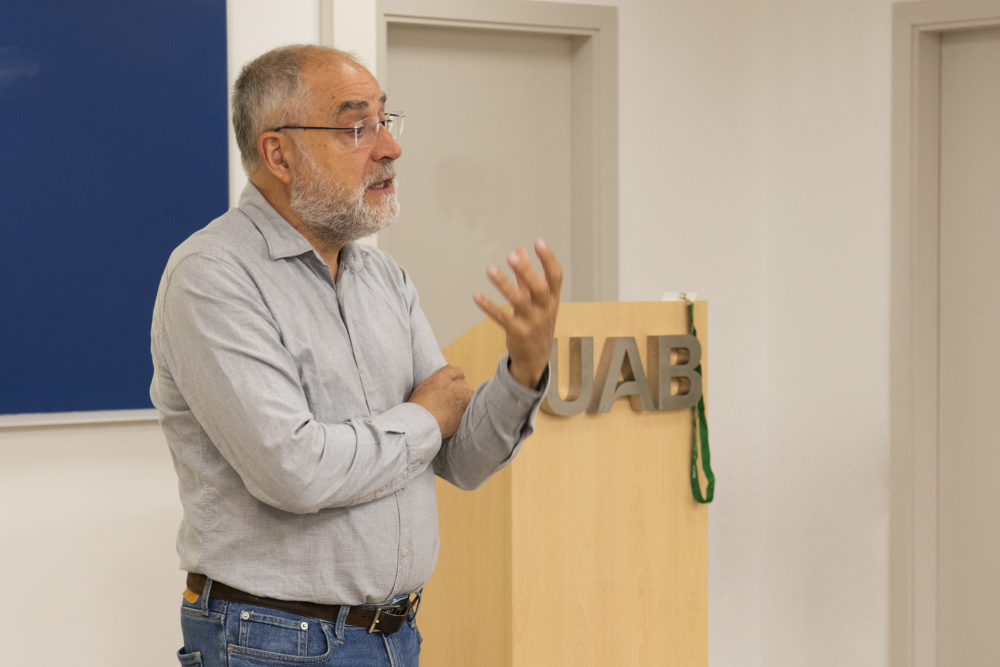
"Discover and Trigger Horizons of Opportunity" was the title of the talk given by Alfons Cornella on May 12 at the Auditorium of the Faculty of Biosciences. Cornella, a theoretical physicist by training, has been dedicated to the field of innovation for the past 30 years, working to understand the implications of change in order to develop tools and systematize the innovation process. Edgers is the project he is currently working on, encouraging companies to be more rebellious and daring in the face of ongoing change.
23/05/2025
A System that is Running Out
Around 30 students and alumni attended the talk, where Cornella pointed out that we are living through one of the most complex moments in history, with all kinds of actors—both new and established—actively participating in the changes taking place across all fields, from energy to construction, education, or mobility. This revolution represents a major opportunity for the next decade to rethink everything that currently works in a certain way: “It’s about questioning current systems and finding alternatives; this is one of the major vectors of the future,” he said.
The future is clearly marked by technology, and China cannot be ignored, as it has for years been the world’s leading innovation engine. Cornella reminded the audience that this is a phenomenon we must take into account, “because the world is being redefined from China.” The context of the future is clearly marked by technology.
What might happen from now to 2048?
The year 2048 will be a crucial moment in the history of humanity, as it will mark the centenary of the Communist Party’s rise to power in China—an important milestone for the country. Until now, the key pillars have been growth based on knowledge in a context of freedom and a society built on efficiency. But this model is running into problems: growth is no longer sustainable, and the current model of freedom cannot guarantee economic dignity for everyone.
The alternative must be rethought around other pillars, such as resilience, which will allow us to be flexible and adapt to whatever happens; finding new ideas for sustainability that support living in balance with the planet; and ensuring that alternatives provide people with economic dignity, which will require them to maximize their curiosity. For Cornella, this new paradigm will bring about countless opportunities.
Companies and people of the future
In this new scenario, companies will need to be able to sense what’s happening around them in order to respond effectively to the market. They will need to identify the necessary technologies and empower their teams to follow more organic models where everyone knows what to do based on their responsibilities. On top of all that, they will need the capacity to build relationships, creating ecosystems through alliances that fill the gaps they can’t reach alone.
The professionals of the future will need to bring solutions that respond to the forces shaping the future, have strong adaptability skills, and be aware that the most meaningful changes will only happen at the edge, without interfering with the internal processes of companies. It will also be key for them to find a balance between the scale of the challenges they take on and the skills needed to meet them. These professionals will need to be curious, rebellious, connected, bold, open to technology, and solution-oriented.
The power of curiosity
The current system is running out of steam, but the model that is to come has yet to emerge. A transformational change is approaching, one that will radically reshape how we innovate and generate ideas—and what will truly make a difference is curiosity. Questions will become the most important thing, which is why Cornella encouraged creating conditions that give rise to stimulating questions. As a result, the value of questions will increase, while the value of answers will decline, because they will be provided by systems based on massive amounts of data. “We have a world of opportunities ahead. We should make the most of our minds and leave to machines what they can do. That way, the outcome can be extraordinary,” Cornella concluded.