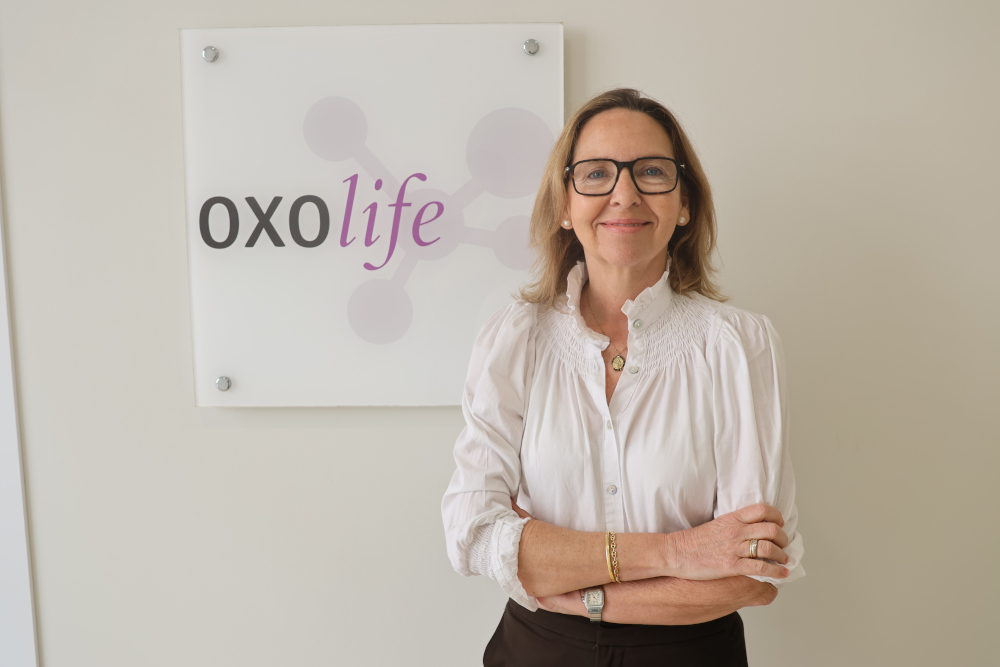
"At Oxolife, we are the first to develop a drug that improves embryo implantation."
"Thanks to our drug, the success rates of assisted reproduction improve, and the number of induction and transfer cycles can be reduced."
"Medicine is a fascinating degree — I wish I had had more time to study it more thoroughly."
Agnès Arbat, co-founder and CEO at Oxolife, a biotechnology company specialized in improving female fertility, is an Alumni of the UAB, having graduated with a degree in Medicine in 1998. She has won the 2025 European Prize for Women Innovators, which honors women who have founded successful companies and brought innovation to the market.
18/06/2025
Agnès Arbat, co-founder and CEO at Oxolife, a biotechnology company specialized in improving female fertility, is an Alumni of the UAB, having graduated with a degree in Medicine in 1998. She has won the 2025 European Prize for Women Innovators, which honors women who have founded successful companies and brought innovation to the market.
– Congratulations on the 2025 European Prize for Women Innovators, an award that highlights the role of women in leadership, entrepreneurship, and innovation.
A: Thank you! I’m very happy for this recognition. Winning came as a surprise. Almost 400 women applied, and seven of us were shortlisted. We each gave a 5-minute pitch and went through a 30-minute jury Q&A. You don’t know if you’ve won until you’re on stage and they announce it.
– Did you find out you had won during the awards ceremony?
A: Yes, right then. They start by announcing the winner — it was so fast! You hardly have time to react. I didn’t expect it, as they often prioritize women from STEM fields, and I thought they wouldn’t choose a woman from a scientific background like mine. It was a huge and deeply emotional joy.
– How did you get to this point?
A: We founded Oxolife in 2013, although we had already been working on it for a couple of years. In the beginning, we only had our own savings and were experimenting with preclinical mouse models. We went from just 9% of mice getting pregnant to 80%. That’s when our first patent came, and from there, we officially created Oxolife — a 100% private initiative, with no support from institutions, hospitals, or universities.
– What is Oxolife?
A: A biotech company focused on women’s health and fertility. We develop innovative drugs to improve fertility, specifically by enhancing embryo implantation and simplifying infertility treatments.
– Is there anything like it on the market?
A: Until now, all existing technologies have focused on stimulating the ovaries to retrieve oocytes, followed by in vitro fertilization (IVF) to create embryos. But once embryos are placed in the uterus, there has been no drug or technology to prepare the endometrium to increase implantation chances. The issue is that in IVF treatments, 3 out of 4 embryos do not implant. We at Oxolife are the first to develop a drug that enhances embryo implantation.
– What results are you seeing?
A: We’ve treated patients diagnosed with infertility who are undergoing assisted reproduction procedures, and embryo implantation rates have increased to 23%. This translates to a 7% increase in live births.
– What does this advancement mean?
A: Thanks to our drug, the chances of success in assisted reproduction treatments improve, and the number of induction and transfer cycles can be reduced. Fertility clinics will also improve their success rates.
– What role does innovation play?
A: It’s always present. This is a field of constant innovation, not only in drug development but also in the technologies we use to validate our models.
– How many people work at Oxolife?
A: We’re four full-time employees and have part-time financial and business advisory support. Everyone is deeply committed. We rely on experts in areas we’re less familiar with. We’ve reached this point thanks to everyone’s work and because we collaborate with private institutions and universities that support us in preclinical, clinical, regulatory, and patent aspects.
– Did you ever imagine becoming an entrepreneur?
A: Never in my life! When I was younger, I never thought I’d start my own company. But when there's such a significant unmet medical need like infertility, and you have an idea, one thing leads to another. There was definitely a bit of recklessness in starting out, but also a lot of hard work, perseverance, flexibility, and learning from everyone. In the end, all of that leads to entrepreneurship.
– Is it very different working for a company versus running your own?
A: Completely different. Large pharmaceutical companies, where I worked before, have processes that take a long time and require many people to make a decision. At Oxolife, the four of us make decisions every week. The advantage is agility — we can act quickly and efficiently. On the downside, we need support from experts who understand that we’re a small biotech needing fast answers and tighter budgets than big pharma. We have less room for error, which is why it’s crucial not to be afraid of making decisions.
– Why did you choose to study Medicine, and why at UAB?
A: I’d do it all over again! Medicine is a fascinating field — understanding the human body and how to solve its problems is what I love most. I wish I’d had more time to study better. I started at the Solivella campus and then moved to Sant Pau Hospital, which is great for students because it’s not too big or too small. We weren’t just observing — doctors let us participate, attend rounds, diagnose, and assist in surgeries. I was very happy at Sant Pau.
– What memories do you have of your time on campus?
A: Studying at UAB meant being quite isolated, and it was wonderful because you spent so much time with your classmates — it created strong group cohesion. We were there all day, with practicals in the morning and classes in the afternoon. I remember a real sense of unity, which is so valuable in a demanding degree like medicine that requires so many hours.
– How did that contribute to your experience at the UAB?
A: In such a demanding degree, having friends going through the same experience makes it feel normal. If you were studying 12 hours a day at UAB, that was fine — your friends were doing the same. I have lifelong friends from those years. The faculty was also outstanding — they made me love the degree from day one.
– Is now a good time to launch a biotech company in Catalonia?
A: This is a great place to start a business. In the healthcare sector, we have a strong, well-established network of hospitals and research centers. We’re also better prepared and able to go further now. The ecosystem is healthy and growing. It’s true that from an investment point of view, robotics and AI are trending right now, and pharmaceuticals require more long-term investment than medical devices. It’s harder to raise funds for drug development, but once you're on the market, the return on investment is very different.
– Where would you like to be in 10 years?
A: I’d like our product to be on the market and helping as many women and families as possible to have the children they want. How do we get there? I’m flexible — it could be through a partnership with a pharmaceutical company or by raising a new investment round. The fastest way to reach patients would be via a collaboration with a pharma company that already has a strong market access, marketing, and sales structure. We’re open to exploring different paths to make it happen.