Interview with Marc Balcells, UAB Criminology Alumni, Class of '07
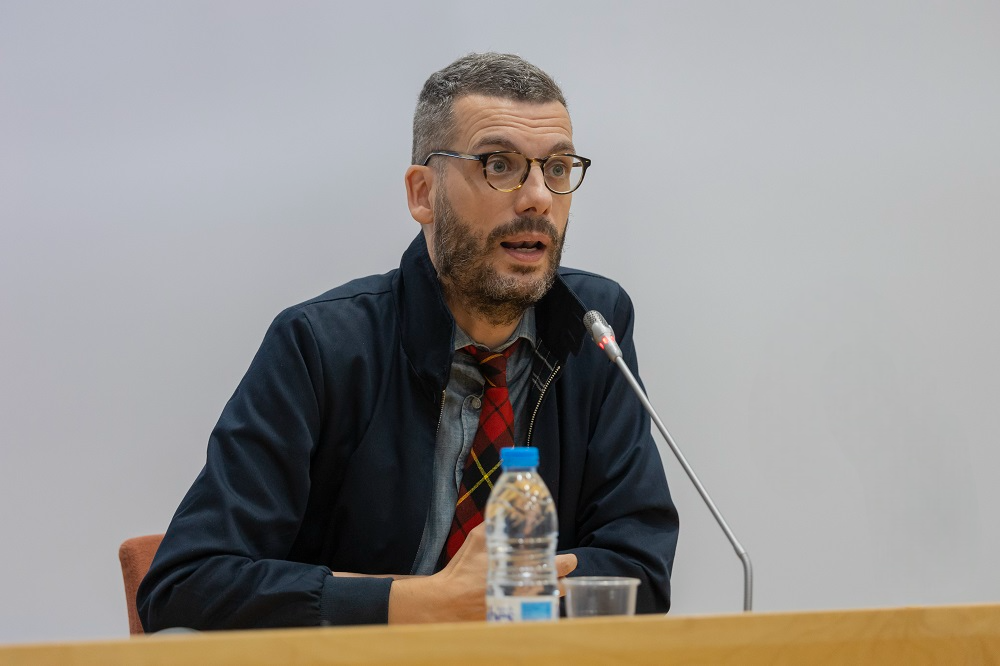
"Before long, we’ll see governments officially recognizing the role of the criminologist."
"I’ve always liked having professors I could admire, and at UAB I found great professionals in the field of Criminology."
Marc Balcells holds a PhD in Criminal Justice from the City University of New York, is the director of the Criminology degree program at the UOC, and author of Arqueomafia: The Tomb Raiders (La Campana, 2025). He is a UAB Criminology Alumni, class of ’07.
21/07/2025
-
On Sant Jordi, you were signing Arqueomafia. Is it as special as people say?
Sant Jordi was a fantastic experience. I absolutely didn’t expect it. The next day you feel happy and exhausted.
-
What led you to turn your doctoral thesis into a book?
My editor proposed it—someone I didn’t know at the time. She emailed me and I was curious. She asked if I could see myself writing a book, and yes, I could. What I couldn’t imagine was how much work it would be. I assumed that since the thesis was already written, converting it into a book would be easier.
-
How did the editor come across you?
She had heard me on La primera pedra on RAC1, in the segment about opera and crime against cultural heritage. I sent 5 or 6 book ideas I’d been thinking about—topics related to criminology, crime… and she was interested in the cultural‑heritage angle. It’s the project I hold most dear.
-
Why was it so hard to write?
They’re completely different things. I had to rewrite the thesis so that it could be understood by a general audience, and it has a completely different style. I worked the manuscript thoroughly.
-
Reading it is like hearing you talk and explaining everything to us.
At first, my editor wasn’t completely convinced about addressing readers so directly, but I believed it wasn’t necessary to deliver a lecture or write an academic essay. I knew my style: guiding readers by the hand—and that’s what I’ve done.
-
How did your interest in grave robbers emerge?
While doing my master’s in Italy in 2011, I read an article about trafficking cultural heritage. That was the seed of what would eventually become my thesis. I spent three years doing fieldwork, interviewing grave robbers, who often justified it by saying they do it as a hobby. Even now, when I travel to places where looting occurs, I try to meet authorities or talk to new grave robbers.
-
And why Criminology?
I’d always been interested, although when I discovered it there were no university programs. While studying Law, I specialized in criminal law courses and always read about the topic. Looking back, I realize I was destined to become a criminologist. When I set up my law office, I bought a laptop, printer, and fax, but I didn’t have a physical office. To meet clients, I always traveled. I went where they told me, in a kind of fieldwork, focusing on their problems: what led them to commit a crime, where they lived, their education level, whether they were at risk of social exclusion, or had psychiatric issues or addictions… I analyzed it from a criminological perspective, more sociological than legal.
-
Where does Criminology stand today?
It’s a crucial moment. Sooner rather than later we will see governments formally recognize the role of the criminologist. Criminology is an empirical science about crime, based on Sociology and Law, aiming to prevent and reduce crime, limit recidivism, and support the des-victimization of victims as soon as possible. There are so many fields we will never run out!
-
What would you say to young people who, influenced by TV crime dramas or noir novels, think they want to become criminologists?
In series and novels, the resolution of an individual crime is often very quick. That’s police or forensic-lab work, which has nothing to do with a criminologist. To work in a lab, you have to be a chemist, biologist, or forensic doctor. If someone put a corpse in front of me asking how they died, I would faint. Criminologists study the cause of crime, prevention, and how society should respond to crime. We’re not interested in one case, but in many cases with enough statistical data to determine what happened and why.
-
So no going to the morgue?
No, never. Criminologists don’t study isolated cases—we study why something happens, like sociologists of crime. We study philosophy, economics, ethnography, crime environments, geography, and toward the end criminal psychology, legal and forensic medicine. In Barcelona, for example, where we have a problem with recidivism, criminologists need to contribute research-based insights about the issue and propose solutions.
-
How did you arrive at UAB?
I had studied Law at UPF and wanted a change of university. I wanted it to be UAB. I didn’t personally know Elena Larrauri or Pepe Cid, who were then professors at UAB, but I had read them a lot as a law student. I’ve always liked having professors to admire—and at UAB I found great criminology professionals. Marcelo F. Aebi, a visiting professor, pushed me into the world of research; he’s one of the reasons I did a PhD thesis. I made a good choice choosing UAB.
-
You’ve been linked to BCNegra. How did you discover crime fiction?
The first novel I remember is The Name of the Rose by Umberto Eco: a Círculo de Lectores edition featuring a photo of a cloister and a rose, given to me by my parents. I was already a big fan of juvenile and children’s crime novels, like Choose Your Own Adventure, where you had to solve cases and they were so fun. I’ve always gravitated toward those types of novels. When I read any other kind of book, I feel like it’s missing a murder. Though I do try to enjoy great literary works, I’m starting to diversify.
-
What kind of reader are you?
Every night I have a crime novel. For me, it's high‑intensity reading focused on criminological themes. I’m a big fan of Michael Connelly, Petros Márkaris, Vázquez Montalbán, the Nordic writers… crime fiction has great literary names. I love books—I underline them, put in post‑its, and take notes.