Undergraduate Launch Program
From idea to product
This extracurricular programme transforms real problems into valuable solutions. Participants work in multidisciplinary teams with the support of experienced professionals.
One project: Several TFGs. One real solution.
Turn your idea into a real product
The UAB Undergraduate Launch Program, promoted by the UAB School of Engineering, is an annual programme designed to teach participants how to identify problems, validate needs, and develop products or services that add value.
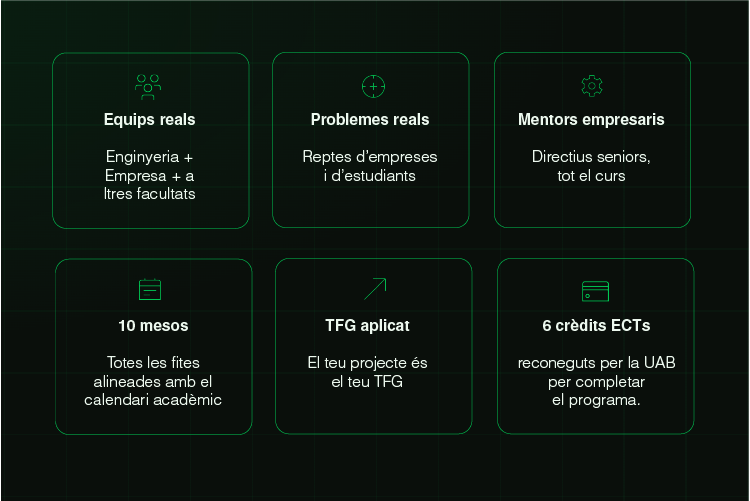
Over the course of ten months, participants will work in multidisciplinary teams, follow a practical entrepreneurial methodology and receive support from senior mentors, applying everything they learn to the development of a real project.
While the programme is primarily intended for fourth-year students from the School of Engineering, it is also open to students from other departments at UAB who wish to contribute an idea, a challenge or their expertise to a project.
Additionally, the project can serve as an Applied Final Degree Project addressing a real-world challenge. The work carried out during the programme can form the basis of each student's individual TFG, adapted to their field of study and the academic requirements of their degree.
Who is this program aimed at?
There are two ways you can participate:
- Do you have an idea or a problem that you want to solve? Present your challenge on Ignition Day, where you can look for students with complementary profiles to form a team.
- Alternatively, if you want to participate but don't have an idea yet, you can join a project that interests you and contribute your talent, knowledge and experience.
The programme seeks to combine different profiles.
What will you learn?
You will learn by doing
The teams will work on their own project, progressively applying the knowledge they have acquired.
- Identify and understand a real problem.
- Define the audience or client to whom the solution is addressed.
- Analyse the market and existing alternatives.
- Formulate a value proposition.
- Design and validate a first prototype.
- Build a minimum viable product.
- Define the business model and marketing strategy.
- Present the project to professionals.
This training programme is based on the 24-step Disciplined Entrepreneurship methodology developed by Bill Aulet at the Massachusetts Institute of Technology (MIT). Each step translates into a specific action or result that is applied to the team's project.
How does it work?
1. Ignition Day: Team Formation
October 2, 2026
This is the day when students with ideas, participants looking for a project and mentors will meet.
The challenges will be presented briefly and the multidisciplinary teams will be formed through different networking activities.
2. Lift-Off: Training, Development and Mentoring
From October to June
The teams will combine:
- Online training content.
- Face-to-face thematic sessions.
- Independent work on the project.
- Regular mentoring with senior professionals.
- Development and validation of the prototype or product.
3. Orbit Day: Final Presentation
July2027
The program will end with a public day in which the teams will present their projects to professionals, representatives of the UAB and agents of the entrepreneurial and business ecosystem.
One project, multiple TFGs
Link the project to your Final Degree Project
The same project can result in several individual, complementary TFGs. For example:
- An engineering student could develop the prototype, architecture, or technical implementation.
- An ADE or economics student could develop the business plan, financial model or marketing strategy.
- A biosciences student could work on scientific validation or a feasibility study.
- Other students can develop areas specific to their degree.
Each TFG project is individual and must be approved by the coordinator of the relevant degree programme, in accordance with the teaching guide and the usual procedures of each centre. Although the project is shared, each student is responsible for their own academic work.
Additional information