Marc Riera: "The master's program led me to a scholarship at the European Central Bank, which was the launchpad for my career."
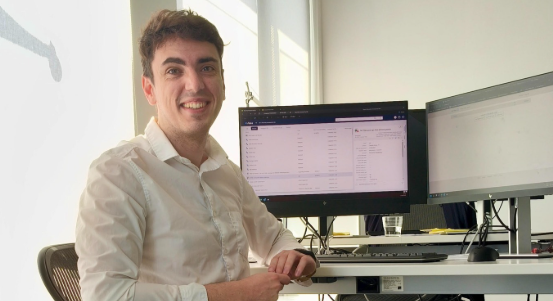
It has been three years since Marc Riera started the adventure of living in another country: he won a scholarship to do an internship at the European Central Bank in Luxembourg as a Business Analyst. Now, he lives in Germany and works for the European Investment Fund with the company EOWIN.
The Master's Degree in Archival and Records Managament from FUAB Formació School has been key to starting his international career.
09/07/2025
- What does a graduate of the Official Master’s in Archival and Records Management need to become a Business Analyst?
In my case, I made the move into this role thanks to a scholarship at the European Central Bank, where I started to gain experience. The role of Business Analyst has many similarities to that of a records manager, with the added responsibility of tasks such as testing and proposing implementations to optimize work and document management within the Investment Fund.
- What has been your professional journey in this field?
I began my career with a one-year scholarship at the European Central Bank, where I worked with electronic documentation, archives, and access management. When the scholarship was about to end, I started applying to various job openings. Having prior experience in a European financial institution greatly helped me access new opportunities. I’ve now been working in the same field for three years, in a similar role, although I also support archival tasks.
- Tell us about your day-to-day work as a Business Analyst at the European Investment Fund. What is the most interesting or exciting part?
My tasks can be grouped into four main areas. First, I focus on the preparation, testing, and implementation of new features. This is the most exciting part of the job, as each new feature presents a different challenge. We meet with the team making the request to understand their needs and assess feasibility. Then, we write the specifications for the software engineers, test the functionality once developed, and finally implement it during a monthly update. The entire process is thoroughly documented.
I also handle user support (helpdesk) and training for new team members. We respond to queries and issues related to the document management system (M-Files) and introduce new employees to how it works. M-Files is fully metadata-based, a concept that can be confusing at first.
Lastly, I also carry out quality control tasks. We review data quality, especially during periods with a lighter workload.
- Why did you choose Luxembourg as your destination? Would you recommend students to go abroad to study and/or work?
Luxembourg is a great place to start a career because there are many opportunities that only require fluency in English, unlike other countries where more languages are needed. Although I have little work experience in Catalonia, I’m very satisfied with my career abroad and would definitely recommend the experience to anyone.
- How has the Master’s program influenced your current career? What skills and knowledge have you applied in the professional environment?
The master’s program opened the door to the scholarship at the European Central Bank, which was the starting point of my career. It also provided me with a solid foundation in electronic records management—knowledge that I’ve been able to apply directly in my professional role.
- How do you think the training received at FUAB Formació School has set you apart from other professionals in your field?
I believe the master’s is quite unique. Many of the professionals I work with, even those in similar fields, don’t have such specialized training. At the European level, I don’t know of many equivalent programs.
- Why would you recommend studying this master’s at FUAB Formació School?
Mainly because of the internship opportunities during the course. These provide direct contact with the working world, which is extremely valuable when starting a professional career.
- What advice would you give to Master’s students who would like to follow a similar path?
I would encourage them to practice their English and, if they already have a good level, to confidently apply for international job opportunities. They are just as well prepared (or even better) than other students across Europe.