Circular Grassroots Innovations for Sustainable and Inclusive Urban Transitions
A European project that examines how grassroots initiatives focused on circularity can transform cities towards more sustainable and inclusive models.
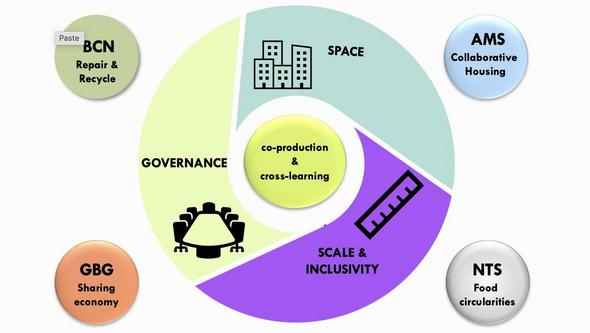
The European project “Circular grassroots innovations for sustainable and inclusive urban transitions” (2023–2026) is an international initiative that investigates the role of citizens, through grassroots collectives and projects dedicated to the circular economy, in the transition towards more sustainable, inclusive, and just cities. Its starting point is that cities are spaces of high environmental pressure and resource of consumption, but also hubs of creativity and social innovation around waste management and reduction. In this context, the project examines the main challenges faced by these initiatives, such as access to spaces for developing their activities, governance and relationships with public administrations, and their capacity to scale up, be replicated, and include diverse groups.
Funded by the Driving Urban Transitions (DUT) programme and the Spanish Research Agency, the project brings together an interdisciplinary team from several European universities and is carried out in four cities, each focusing on different thematic areas: Amsterdam (housing), Gothenburg (social and solidarity economy), Nantes (food), and Barcelona (objects and material resources). In Barcelona, the project involves a team from the University of Barcelona (UB)—focused on the work of informal scrap collectors—and another team from the Universitat Autònoma de Barcelona (UAB), from the Department of Social Psychology, constituted by Blanca Callén (Principal Investigator) and Anastasia Zisakou, postdoctoral researcher. Their work focuses on understanding how two repair and reuse initiatives (the repair communities of Restarters BCN and the Libraries of Things) operate, and which conditions enable or hinder their development. These initiatives not only contribute to waste reduction, especially electronic waste, but also generate social benefits, such as strengthening community networks, fostering collective learning, and improving more equitable access to resources.
El projecte també treballa en estreta col·laboració amb entitats públiques i socials de l’àmbit local, com REZERO, Restarters BCN, l’àrea de Medi Ambient de l’AMB, BIT Habitat o Barcelona Activa, fet que permet connectar la recerca i transferir-ne els aprenentatges a polítiques públiques i pràctiques reals.
As part of the project’s activities, a series of four webinars was recently organised, focusing on: (1) metabolic contributions; (2) environmental conflicts and disputes; (3) value creation beyond monetisation; and (4) spatial governance regimes associated with grassroots initiatives working on circularity.
Another outcome of the project is the academic article: Zisakou, A., & Callén Moreu, B. (2026). Towards inclusive urban transitions: An intersectional analysis of reuse and repair grassroots initiatives in Barcelona. Local Environment, 1–21. (DOI)
Through this participation, the Department reinforces its commitment to research addressing current ecosocial challenges, highlighting the role of citizens and collective action as key to building more sustainable and inclusive urban models.